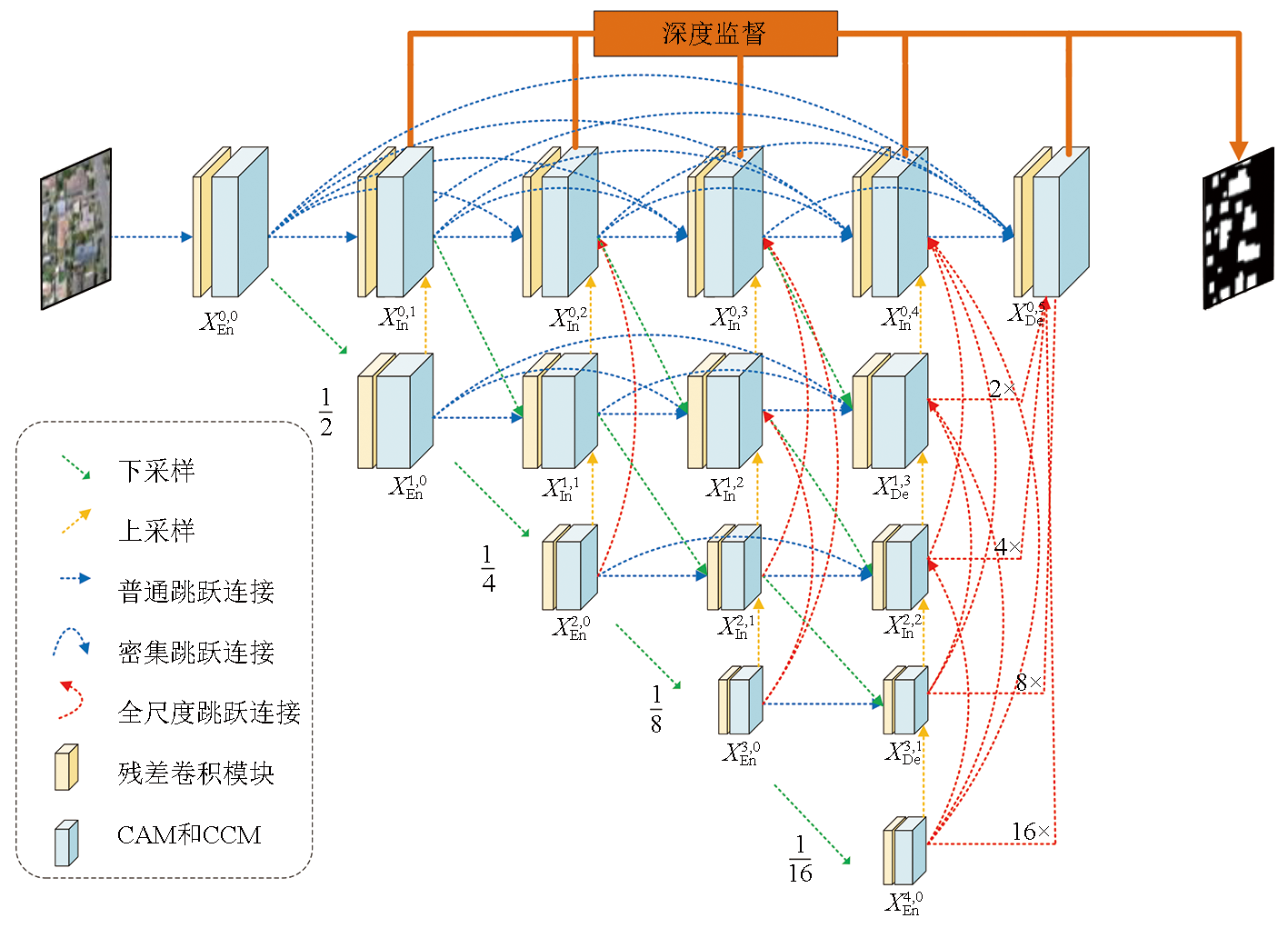
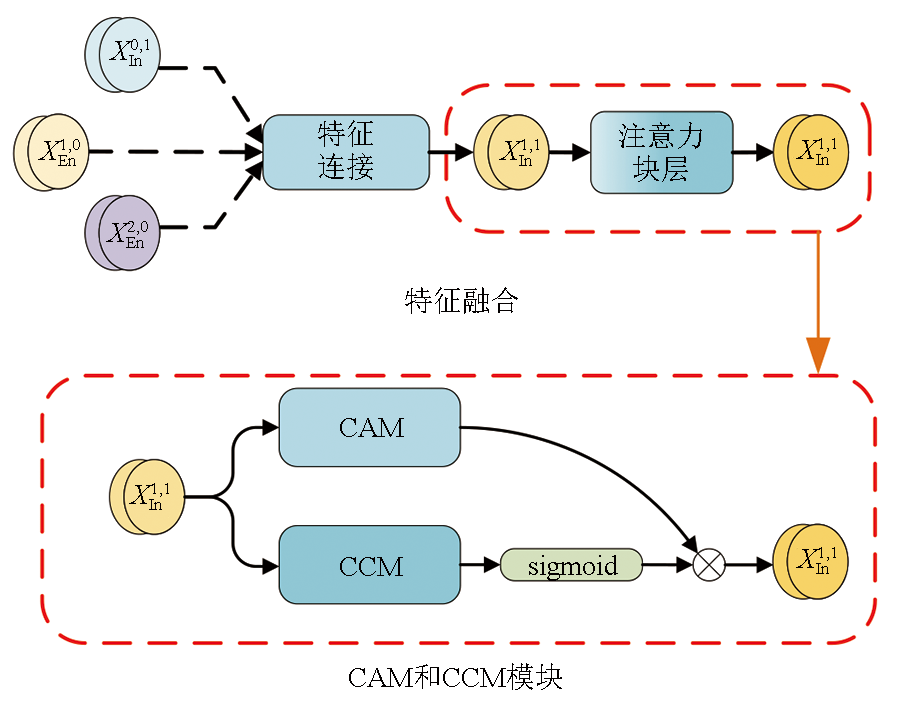
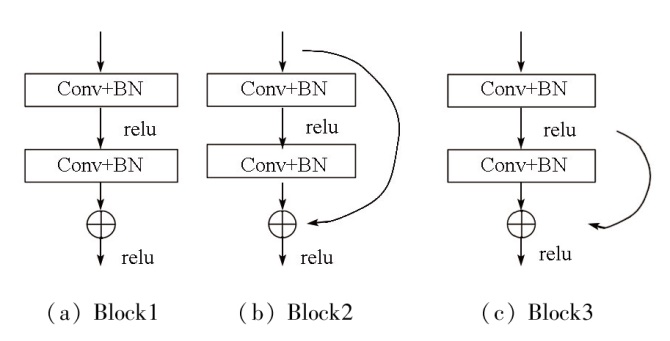
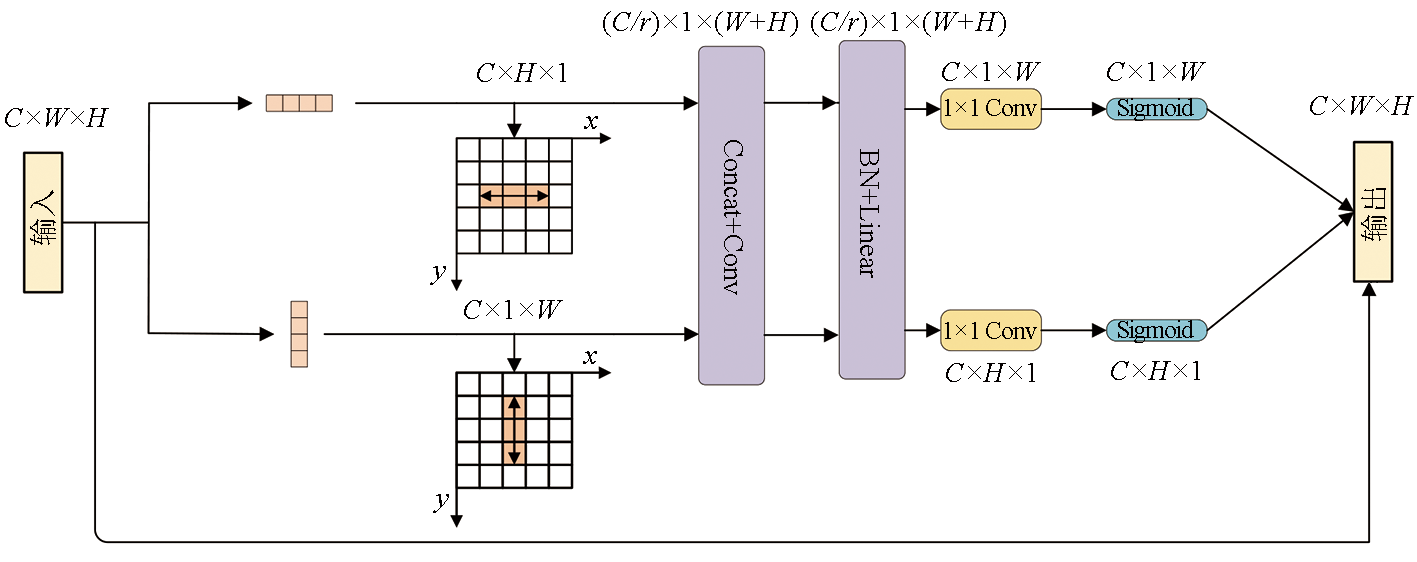
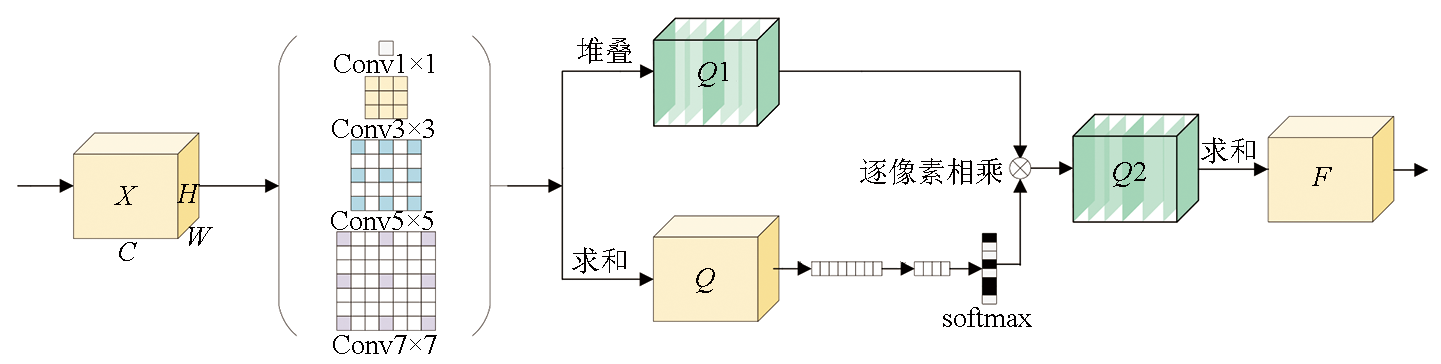
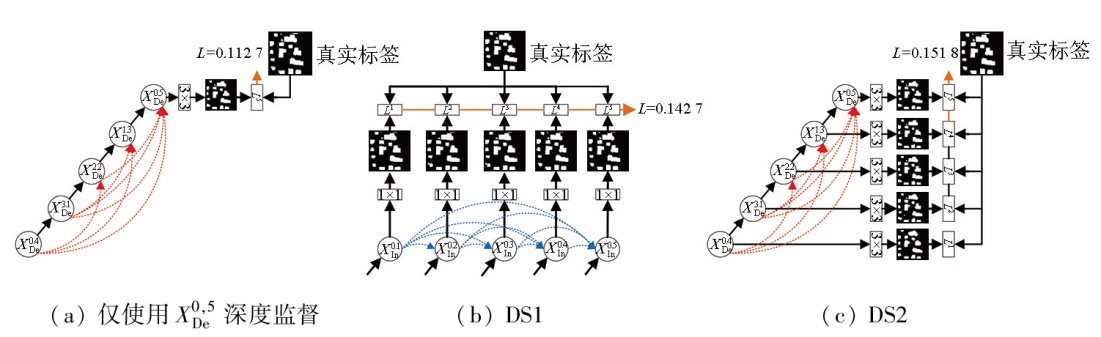
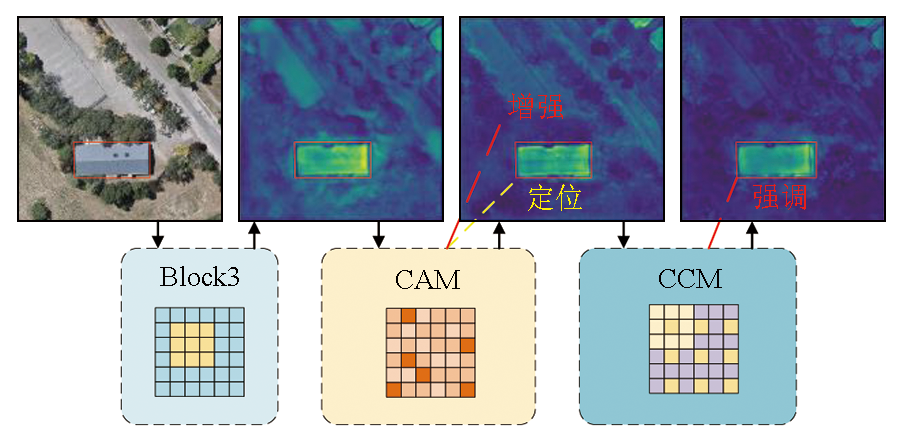
Building extraction aims to separate building pixels from remote sensing images, which plays a crucial role in applications such as urban planning and urban dynamic monitoring. However, building extraction generally faces challenges, such as void, false positives, and false negatives. Given this, this paper proposed a densely nested network (DN-Net). The sub-networks in the DN-Net were integrated with the enhanced residual convolutional module (ERCM) to extract rough contours of buildings from remote sensing images. Furthermore, to accurately locate the buildings, a coordinate attention module (CAM) was incorporated, effectively avoiding false positives. To deal with the holes during building extraction, a cascade convolutional module (CCM) was used, allowing the extraction of richer details with convolution kernels of various sizes, thereby ensuring accurate building extraction. The DN-Net was tested with the WHU datasets to assess its accuracy. The results showed that the DN-Net exhibited an intersection over union (IoU) of 89.20% and a F1 score of 94.29% on the validation set and 89.85% and 94.65%, respectively, on the test set. The results confirm that the DN-Net can significantly improve the building extraction accuracy, with more complete and detailed boundaries of buildings being extracted, demonstrating an outstanding ability to extract buildings of varying sizes.
刘毅, 刘涛, 高天迎, 李国燕. DN-Net:密集嵌套网络的遥感建筑物提取[J]. 自然资源遥感, 2025, 37(6): 77-87.
LIU Yi, LIU Tao, GAO Tianying, LI Guoyan. DN-NET: A densely nested network for building extraction from remote sensing images. Remote Sensing for Natural Resources, 2025, 37(6): 77-87.
Chen J, Xia M, Wang D, et al. Double branch parallel network for segmentation of buildings and waters in remote sensing images[J]. Remote Sensing, 2023, 15(6):1536.
doi: 10.3390/rs15061536
[2]
Ji X, Tang L, Lu T, et al. DBENet:Dual-branch ensemble network for sea-land segmentation of remote-sensing images[J]. IEEE Transactions on Instrumentation and Measurement, 2023,72:5503611.
[3]
Shelhamer E, Long J, Darrell T. Fully convolutional networks for semantic segmentation[J]. IEEE Transactions on Pattern Analysis and Machine Intelligence, 2017, 39(4):640-651.
doi: 10.1109/TPAMI.2016.2572683
pmid: 27244717
[4]
Ronneberger O, Fischer P, Brox T. U-net:Convolutional networks for biomedical image segmentation[M]//Lecture Notes in Computer Science. Cham: Springer International Publishing, 2015:234-241.
[5]
Badrinarayanan V, Kendall A, Cipolla R. SegNet:A deep convolutional encoder-decoder architecture for image segmentation[J]. IEEE Transactions on Pattern Analysis and Machine Intelligence, 2017, 39(12):2481-2495.
doi: 10.1109/TPAMI.2016.2644615
pmid: 28060704
[6]
Noh H, Hong S, Han B. Learning deconvolution network for semantic segmentation[C]//2015 IEEE International Conference on Computer Vision (ICCV).December 7-13,2015, Santiago,Chile.IEEE, 2015:1520-1528.
[7]
Chen L C, Papandreou G, Kokkinos I, et al. DeepLab:Semantic image segmentation with deep convolutional nets,atrous convolution,and fully connected CRFs[J]. IEEE Transactions on Pattern Analysis and Machine Intelligence, 2018, 40(4):834-848.
doi: 10.1109/TPAMI.2017.2699184
[8]
Chen LC, Papandreou G, Schroff F, et al. Rethinking atrous convolution for semantic image segmentation[J]. arXiv preprint arXiv:170605587, 2017.
[9]
Chen L C, Zhu Y, Papandreou G, et al. Encoder-decoder with atrous separable convolution for semantic image segmentation[M]//Lecture Notes in Computer Science. Cham: Springer International Publishing, 2018:833-851.
[10]
Paszke A, Chaurasia A, Kim S, et al. ENet:A deep neural network architecture for real-time semantic segmentation[J/OL].(2016-06-07).https://arxiv.org/abs/1606.021470.
[11]
Romera E, Álvarez J M, Bergasa L M, et al. ERFNet:Efficient residual factorized ConvNet for real-time semantic segmentation[J]. IEEE Transactions on Intelligent Transportation Systems, 2018, 19(1):263-272.
doi: 10.1109/TITS.2017.2750080
[12]
Lin J, Jing W, Song H, et al. ESFNet:Efficient network for building extraction from high-resolution aerial images[J]. IEEE Access, 2822,7:54285-54294.
[13]
Zhou Z W, Rahman Siddiquee MM, Tajbakhsh N, et al. Unet++:A nested u-net architecture for medical image segmentation[C]//Deep Learning in Medical Image Analysis and Multimodal Learning for Clinical Decision Support:4th International Workshop, DLMIA 2018,and 8th International Workshop,ML-CDS 2018,Held in Conjunction with MICCAI 2018,Granada,Spain,September 20,2018,Proceedings 4.Springer, 2018:3-11.
[14]
Huang H, Lin L, Tong R, et al. UNet 3:A full-scale connected UNet for medical image segmentation[C]// ICASSP 2020-2020 IEEE International Conference on Acoustics,Speech and Signal Processing (ICASSP). May 4-8,2020, Barcelona,Spain.IEEE, 2020:1055-1059.
[15]
Liu Z, Lin Y T, Cao Y, et al. Swin transformer: Hierarchical vision transformer using shifted windows[C]//2021 IEEE/CVF International Conference on Computer Vision (ICCV).Montreal,QC,Canada. IEEE, 2021:9992-10002.
Wang Z Q, Zhou Y, Wang S X, et al. House building extraction from high-resolution remote sensing images based on IEU-Net[J]. National Remote Sensing Bulletin, 2021, 25(11):2245-2254.
doi: 10.11834/jrs.20210042
Zhang L T, Kong W X, Luo Y Y, et al. Improved LinkNet building extraction method for high resolution remote sensing image[J]. Science of Surveying and Mapping, 2022, 47(9):120-127,145.
Long L H, Zhu Y T, Yan J W, et al. New building extraction method based on semantic segmentation[J]. National Remote Sensing Bulletin, 2023, 27(11):2593-2602.
doi: 10.11834/jrs.20211029
Lyu S Y, Li J T, A X H, et al. Res_ASPP_UNet++:Building an extraction network from remote sensing imagery combining depthwise separable convolution with atrous spatial pyramid pooling[J]. National Remote Sensing Bulletin, 2023, 27(2):502-519.
doi: 10.11834/jrs.20210477
Liu C C, Ge X S, Wu Y B, et al. A method for information extraction of buildings from remote sensing image based on hybrid attention mechanism and Deeplabv3+[J] Remote Sensing for Natural Resource, 2025, 37(1):31-37.doi:10.6046/zrzyyg.2023295.
Ji S P, Wei S Q. Building extraction via convolutional neural networks from an open remote sensing building dataset[J]. Acta Geodaetica et Cartographica Sinica, 2019, 48(4):448-459.
[22]
Lee C Y, Xie S, Gallagher P, et al. Deeply-supervised nets[C]// Artificial Intelligence and Statistics. PMLR, 2015:562-570.
 2025, Vol. 37
  ), 刘涛, 高天迎(