1. College of Water Conservancy, Yunnan Agricultural University, Kunming 650201,China 2. Green Smart Agricultural Field and Carbon Emission Reduction Engineering Research Center of University in Yunnan Province, Kunming 650201, China 3. International Joint Research and Development Centre for Smart Agriculture and Water Security in Yunnan, Kunming 650201, China 4. Field Scientific Observation and Research Station of Yunnan Intermountain Basin Land Utilization of Ministry of Natural Resources, Kunming 650201, China
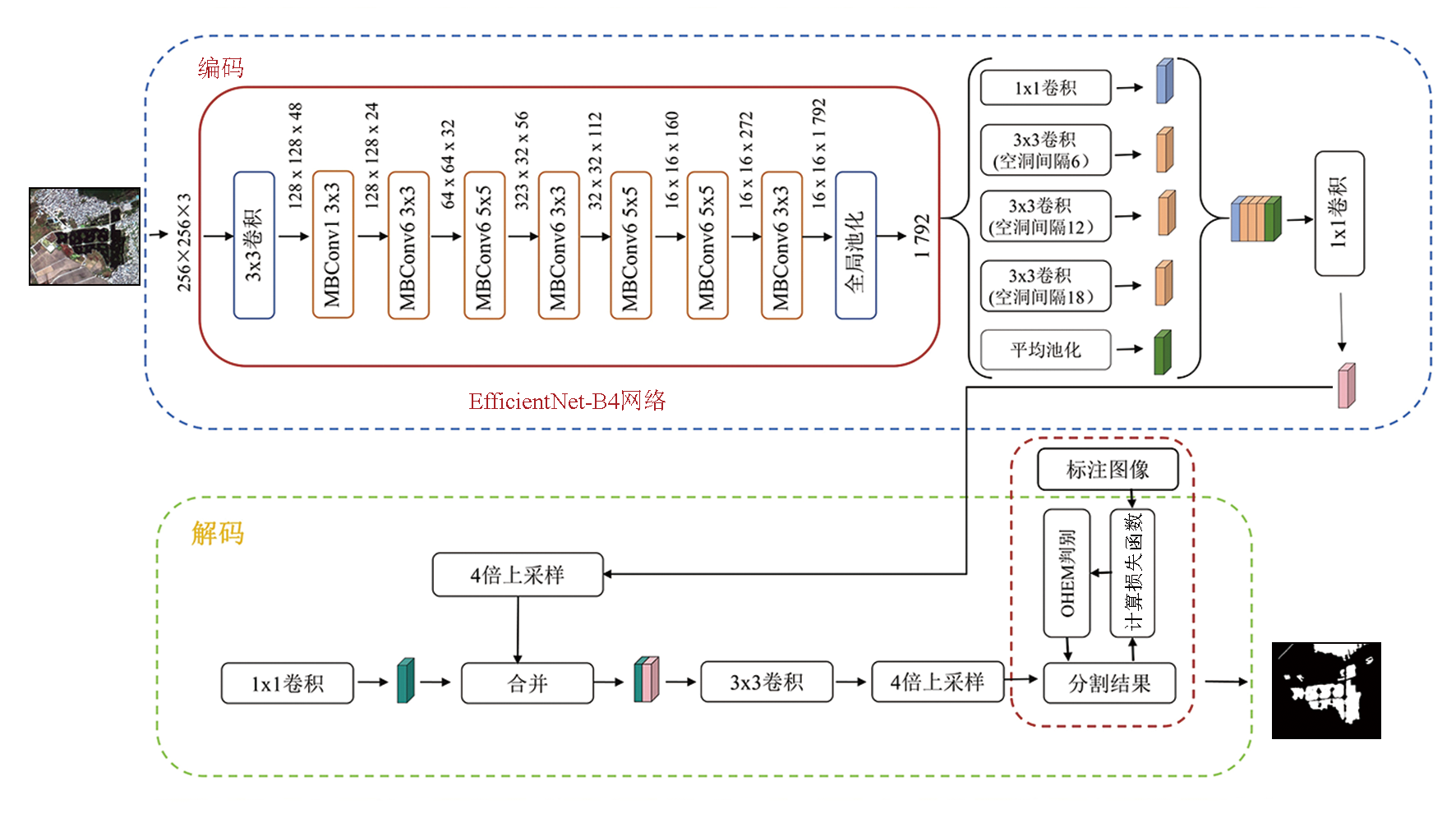
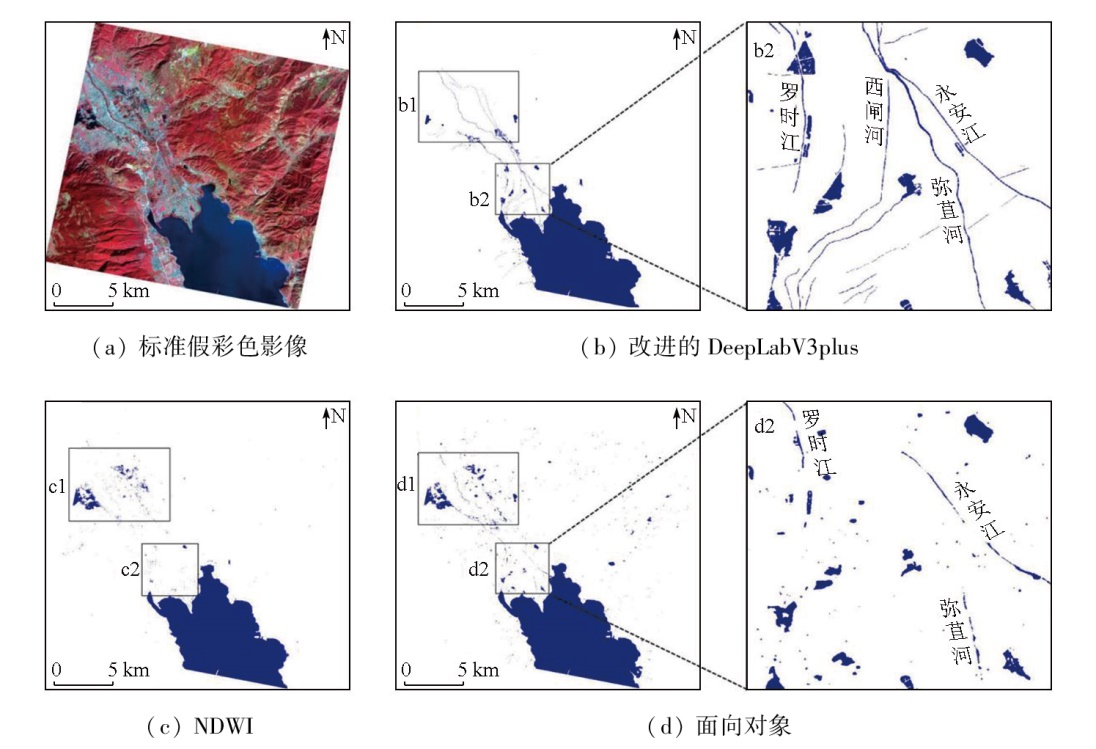
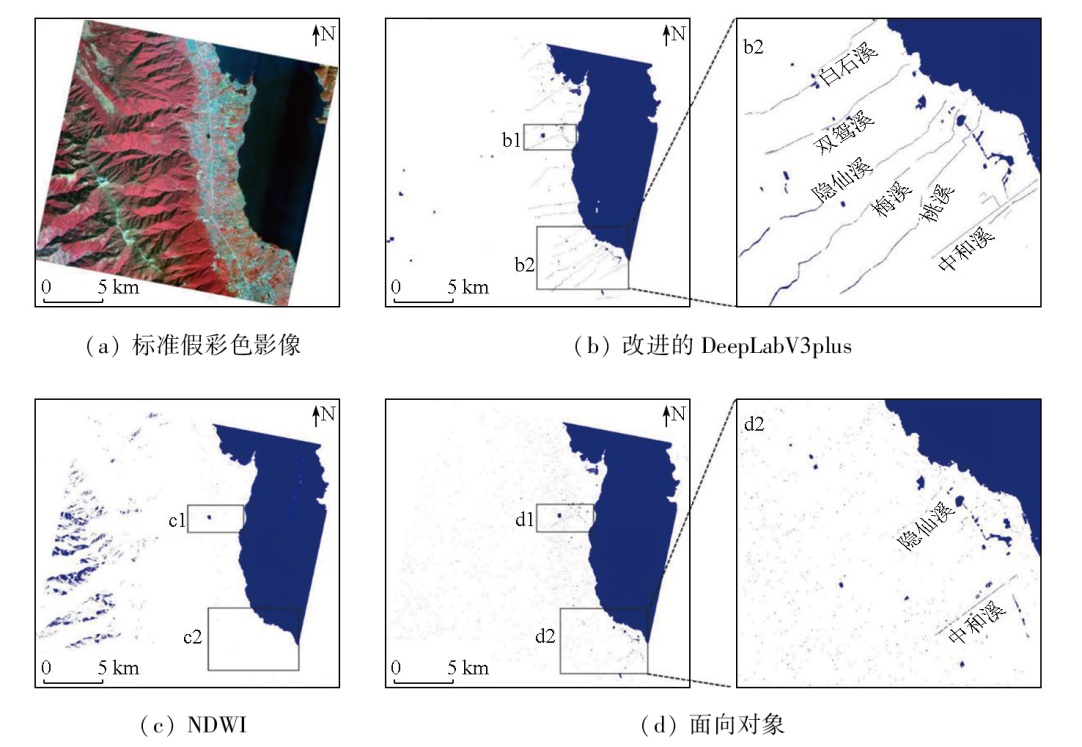
Traditional methods for information extraction of small water bodies suffer from poor performance and low accuracy, failing to meet actual needs. Using the high-resolution images of the Erhai Lake basin from the Jilin-1 domestic satellite as the data source, this study proposed a deep learning-based semantic segmentation method using an improved DeepLabV3plus model. Replacing the ResNet-101 encoder with EfficientNet-B4, this study innovatively combined the BCE Loss and Dice Loss functions, identifying the optimal method for fine-scale information extraction of water bodies in the Erhai Lake Basin. The results indicate that compared to traditional methods, the improved DeepLabV3plus model performed better in the information extraction of water boundaries, enabling accurate identification of main water bodies, especially small streams. The improved DeepLabV3plus model exhibited higher precision (98.87%), recall (99.30%), and F1-Score (99.08%) than the normalized difference water index (NDWI) and object-oriented methods. Regarding comparison of details, the improved DeepLabV3plus model can effectively suppress the influence of building shadows, vegetation occlusion, and complex surface features, improving the information extraction effects of small water bodies and complex edge areas. In addition, ablation experiments show that the introduction of the combined loss functions and compound scaling strategy increased mIoU by 0.62% and 3.07%, respectively, significantly enhancing the model's segmentation accuracy and ability to extract multi-scale semantic information.
张莹, 陈运春, 郭晓飞, 吴晓聪, 陈凤林, 曾维军. 基于改进DeepLabV3plus架构的洱海流域水体精细提取[J]. 自然资源遥感, 2025, 37(6): 201-210.
ZHANG Ying, CHEN Yunchun, GUO Xiaofei, WU Xiaocong, CHEN Fenglin, ZENG Weijun. Fine-scale information extraction of water bodies in the Erhai Lake Basin based on an improved DeepLabV3plus architecture. Remote Sensing for Natural Resources, 2025, 37(6): 201-210.
Li Z, Zhu Q Q, Yang J H, et al. A cross-domain object-semantic matching framework for imbalanced high spatial resolution imagery water-body extraction[J]. IEEE Transactions on Geoscience and Remote Sensing, 2024,62:5629015.
Yang X Z, Zhou Y N, Zhang X, et al. Accurate extraction of artificial pit-pond integrating edge features and semantic information[J]. Journal of Geo-Information Science, 2022, 24(4):766-779.
Xue Y, Qin C, Wu B S, et al. Automatic extraction of mountain river information from multiple Chinese high-resolution remote sensing satellite images[J]. Journal of Tsinghua University (Science and Technology), 2023, 63(1):134-145.
Xu H Q. A study on information extraction of water body with the modified normalized difference water index (MNDWI)[J]. Journal of Remote Sensing, 2005, 9(5):589-595.
[5]
Feyisa G L, Meilby H, Fensholt R, et al. Automated water extraction index:A new technique for surface water mapping using Landsat imagery[J]. Remote Sensing of Environment, 2014,140:23-35.
Wang C X, Zhang J, Li Y X, et al. A multi-band combination water index model based on Landsat8[J]. Bulletin of Surveying and Mapping, 2022(5):20-25.
[7]
Rishikeshan C A, Ramesh H. An automated mathematical morphology driven algorithm for water body extraction from remotely sensed images[J]. ISPRS Journal of Photogrammetry and Remote Sensing, 2018,146:11-21.
Li H X, Shi Y, Ding Z J, et al. Combining multi-source remote sensing data and object-oriented wetland information extraction in arid areas[J]. Environmental Science, 2025, 46(5):3127-3138.
doi: 10.1021/es204272v
[9]
Shelhamer E, Long J, Darrell T. Fully convolutional networks for semantic segmentation[J]. IEEE Transactions on Pattern Analysis and Machine Intelligence, 2017, 39(4):640-651.
doi: 10.1109/TPAMI.2016.2572683
pmid: 27244717
Meng Y B, Wang J, Liu G H. Multi-level feature enhancement aggregation for fine water extraction in remote sensing images[J]. Journal of Detection & Control, 2023, 45(6):123-134.
[11]
Tan M, Le Q. EfficientNet:Rethinking model scaling for convolutional neural networks[C]// Proceedings of the 36th International Conference on Machine Learning. PMLR, 2019:6105-6114.
Yang P Y, Li S Y. Analysis on environmental protection and comprehensive management in Erhai Lake Basin[J]. Journal of Green Science and Technology, 2019(14):197-198.
He Z L, Chen Y C, Guo X F, et al. Applicability of land use classification in Erhai Basin based on FSO algorithm[J]. Agricultural Engineering, 2024, 14(9):126-133.
[14]
贾波. 基于高分一号卫星影像的水体信息提取方法初探[J]. 经纬天地, 2024(3):6-10.
Jia B. Preliminary exploration on water body information extraction method based on Gaofen No.1 satellite image[J]. Survey World, 2024(3):6-10.
[15]
Shorten C, Khoshgoftaar T M. A survey on image data augmentation for deep learning[J]. Journal of Big Data, 2019, 6(1):60.
doi: 10.1186/s40537-019-0197-0
Mao Z M, Liu Q, Peng E R, et al. Puzhehei River Basin water body information extraction based on the typical karst area of NEWI model[J]. China Rural Water and Hydropower, 2021(1):71-75.
Ma D H, Cui W Z, Feng X J, et al. A method for accurately extracting the water surface of pits and ponds in areas with multiple water body types[J]. Science of Surveying and Mapping, 2023, 48(11):104-116.
Wang Y, Dong Y K, He Z L, et al. Extraction of compound rotation planting structure based on Sentinel-2A image[J]. Journal of Southern Agriculture, 2023, 54(8):2490-2498.
Dong Z, Wang L, Zhu X C, et al. Water extraction in mountainous area based on spectral model and object-oriented method[J]. Remote Sensing Information, 2022, 37(4):121-127.
Shen Q H, Zhang H J, Xu Y W, et al. Comprehensive survey of loss functions in knowledge graph embedding models[J]. Computer Science, 2023, 50(4):149-158.
doi: 10.11896/jsjkx.211200175
Nan G J, Wang M, Du H B, et al. The research on semantic segmentation of remote sensing image about ground objects based on improved Deeplabv3+ model[J]. Control and Decision, 2025, 40(2):423-431.
[22]
Zhou Z W, Siddiquee M M R, Tajbakhsh N, et al. UNet++:A nest-ed U-Net architecture for medical image segmentation[J/OL]. 2018(2018-07-18).https://arxiv.org/abs/1807.10165v1.
[23]
Sandler M, Howard A, Zhu M, et al. MobileNetV2:Inverted residuals and linear bottlenecks[C]// Proceedings of the IEEE Conference on Computer Vision and Pattern Recognition (CVPR). IEEE, 2018:4510-4520.
Zhang Y L, Jiang C B, Long Y N, et al. Dynamic monitoring of water area in Dongting Lake during flood season based on sentinel-1A SAR data[J]. Remote Sensing Technology and Application, 2024, 39(3):741-752.
Qiao D Y, Zheng J H, Lu H, et al. Application of water extraction methods from Landsat imagery for different environmental background[J]. Journal of Geo-Information Science, 2021, 23(4):710-722.
Wen Q, Li L, Xiong L, et al. A review of water body extraction from remote sensing images based on deep learning[J]. Remote Sensing for Natural Resources, 2024, 36(3):57-71.doi:10.6046/zrzyyg.2023106.
[27]
Li X, Strahler A H. Geometric-optical bidirectional reflectance modeling of the discrete crown vegetation canopy:Effect of crown shape and mutual shadowing[J]. IEEE Transactions on Geoscience and Remote Sensing, 1992, 30(2):276-292.
doi: 10.1109/36.134078
Li W T, Tong X, Li D R, et al. Production of DSM based on image located at edge of view of sub meter WFV satellite[J]. Remote Sensing Information, 2024, 39(2):61-69.
[29]
Small C. The Landsat ETM+ spectral mixing space[J]. Remote Sensing of Environment, 2004, 93(1/2):1-17.
doi: 10.1016/j.rse.2004.06.007
Xie W C, Li Q F, Li Y C, et al. Object-oriented classification of wetland vegetation community in Jilin-1 remote sensing image[J]. Forest Resources Management, 2023(1):141-152.
 2025, Vol. 37
  ), 陈运春1,2,3,4, 郭晓飞1,2,3,4, 吴晓聪1, 陈凤林1, 曾维军1,2,3,4(