|
|
 |
|

|
|
|
Analyzing water area changes and inundation trends in Siling Co during 1995—2023 based on multi-source remote sensing |
WANG Haochen1,2( ), HE Peng1,2(), CHEN Hong2, TONG Liqiang2, GUO Zhaocheng2, TU Jienan2, WANG Genhou1 ), HE Peng1,2(), CHEN Hong2, TONG Liqiang2, GUO Zhaocheng2, TU Jienan2, WANG Genhou1 |
1. School of Earth Science and Resources, China University of Geosciences(Beijing), Beijing 100083, China
2. China Aero Geophysical Survey & Remote Sensing Center for Natural Resources, Beijing 100083, China |
|
|
|
|
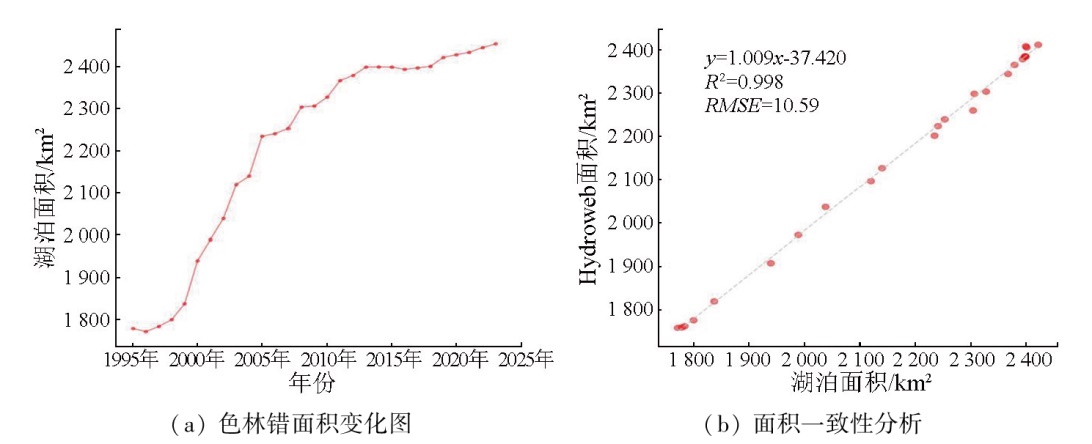
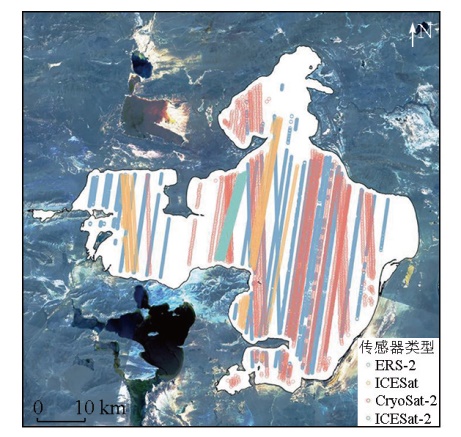
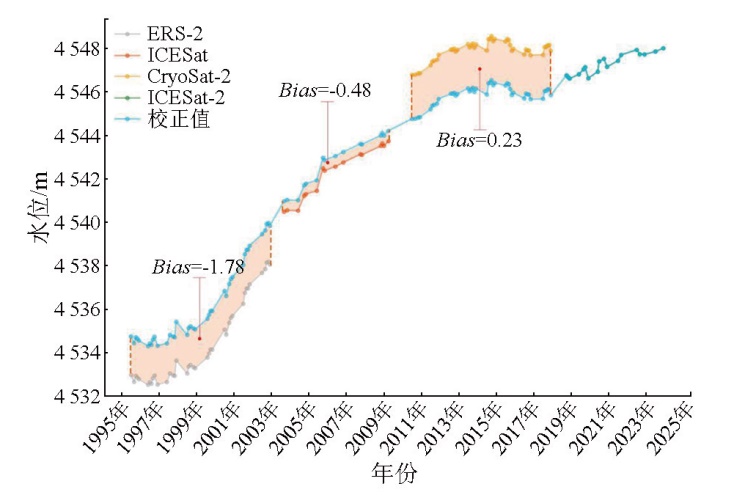
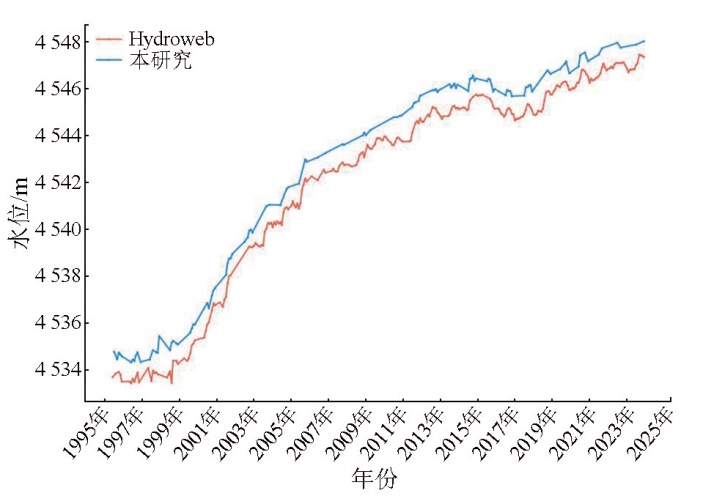
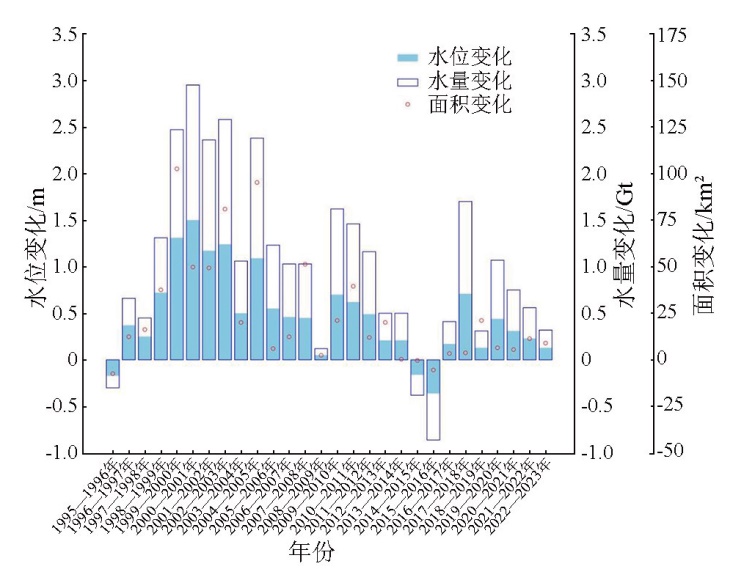
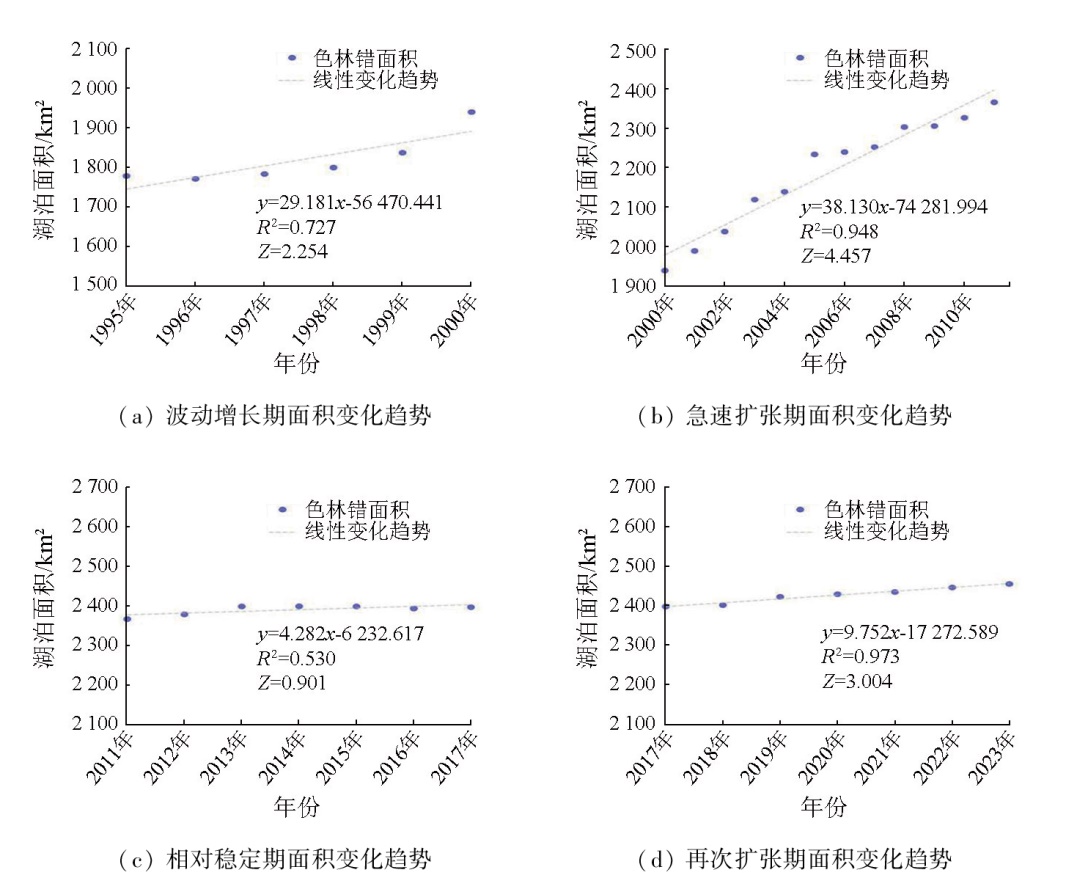
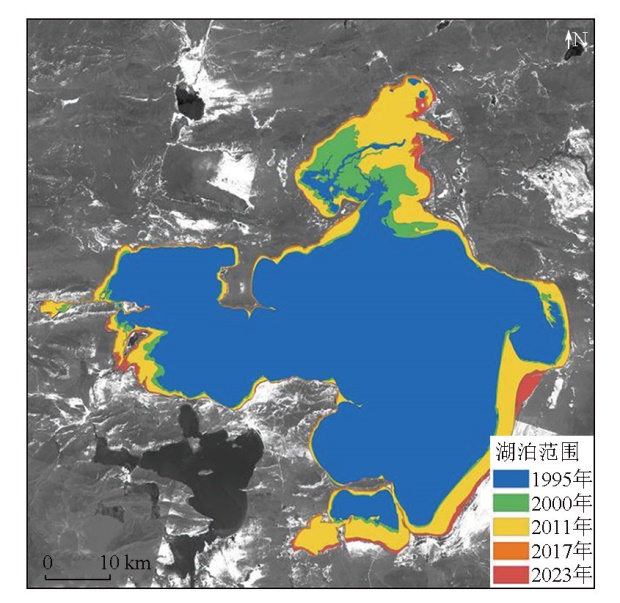
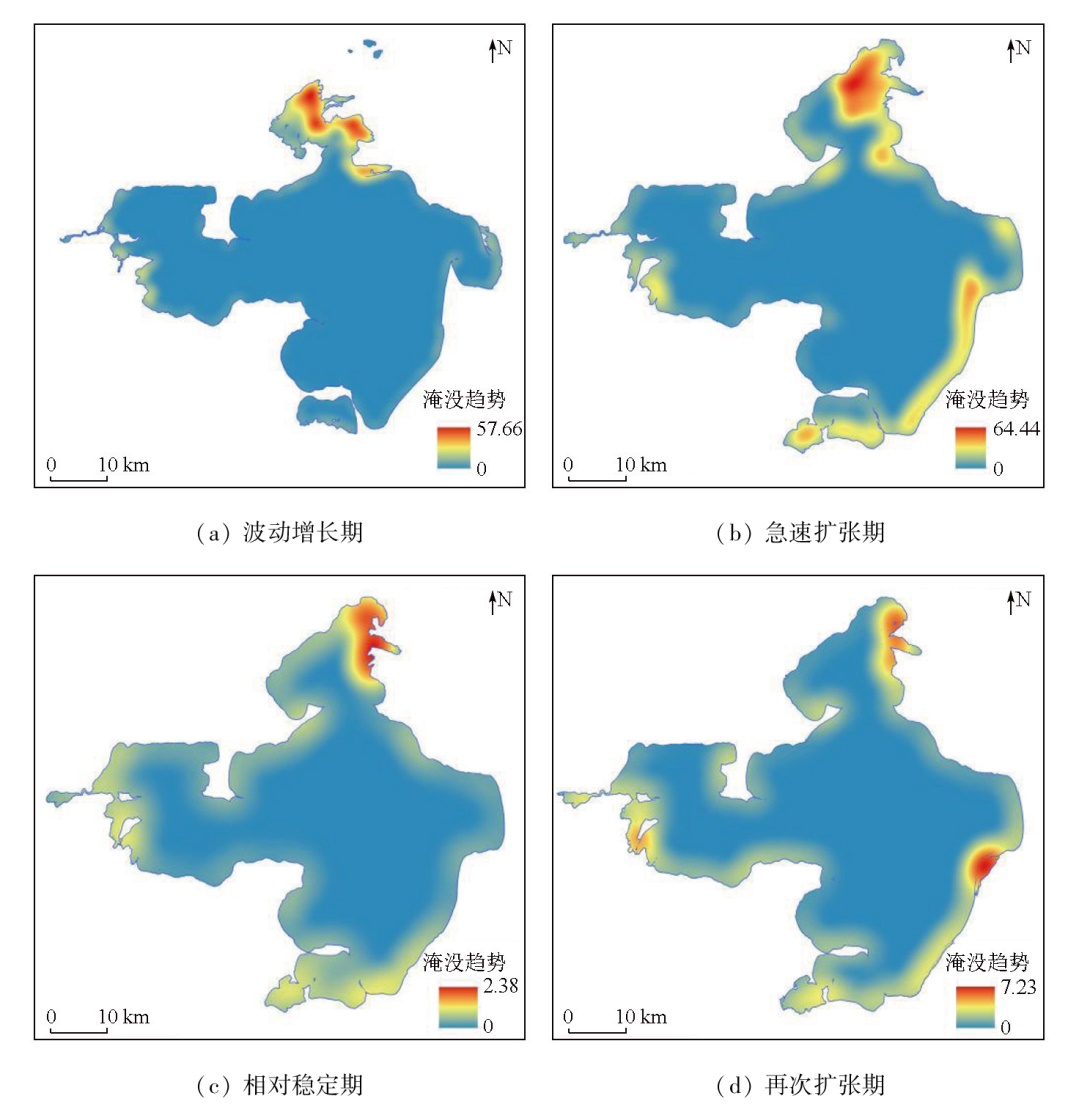
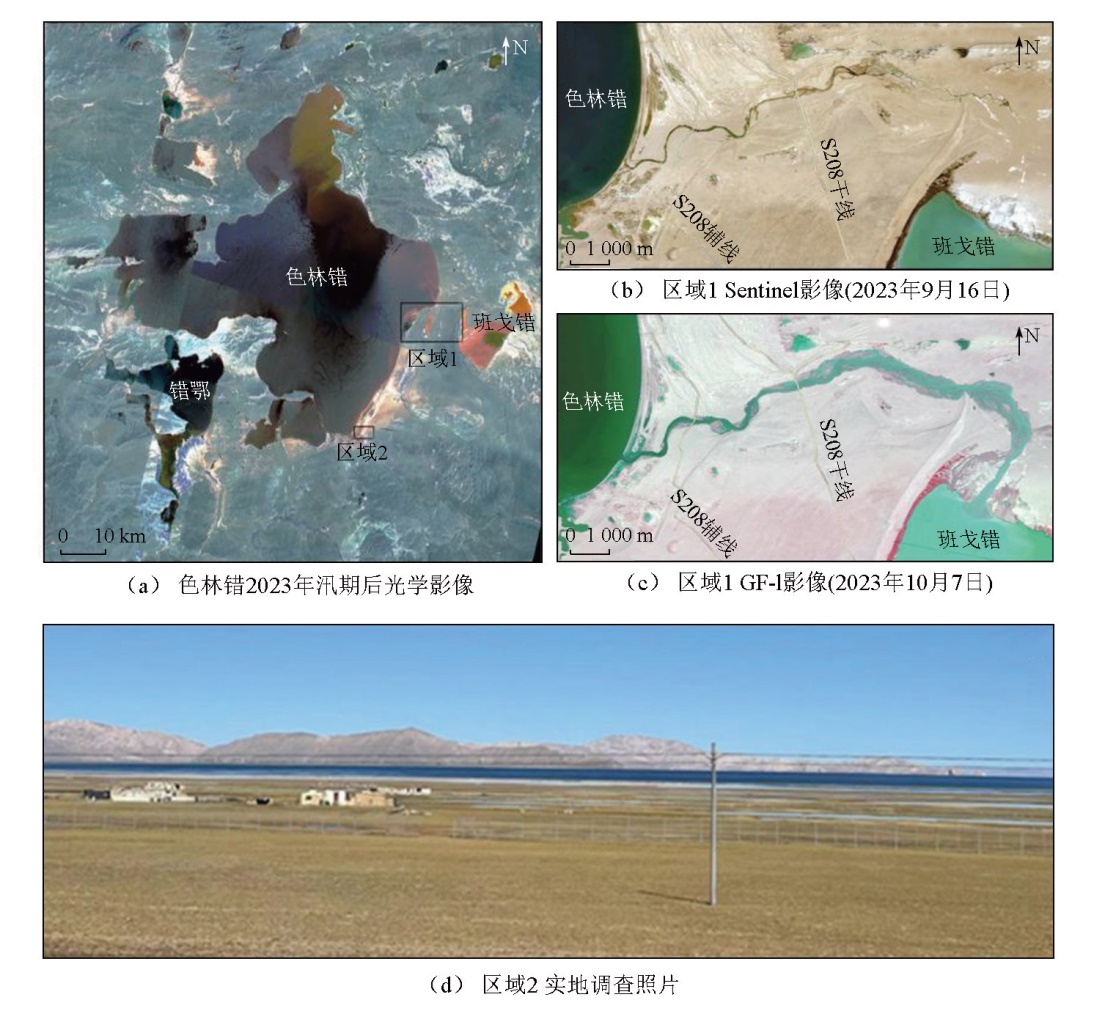
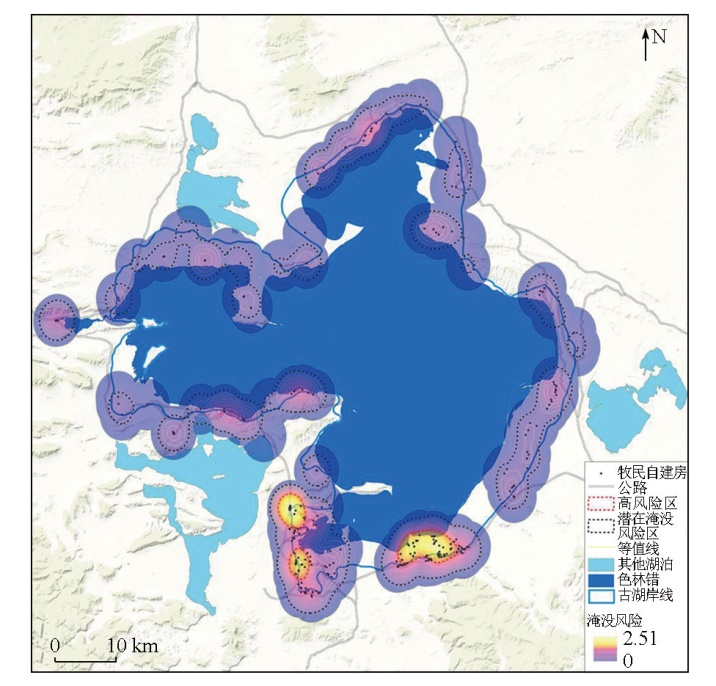
Abstract Siling Co, the largest lake in Xizang Autonomous Region, has expanded significantly in the past few years, threatening surrounding pastoral activities, infrastructures, and even the ecological environment. This study systematically reconstructed the time series of changes in the lake area, water level, and water volume of Siling Co from 1995 to 2023 using optical images from satellites Landsat and GF, as well as altimeter data from satellites ERS-2, ICEsat, Cryosat-2, and ICEsat-2. Through Mann-Kendall trend analysis, the study determined the stages of the lake area changes and revealed the key characteristics of various stages. Furthermore, it also made a preliminary judgement on the inundation trend and its impacts. The results indicate that from 1995 to 2023, Siling Co experienced an increase in water area of 676.75 km2 (with an annual average of 24.17 km2/a), a water level rise of approximately 13.32 m (with an annual average of 0.48 m/a), and a water volume growth of 28.45 Gt (with an annual average of 1.02 Gt/a). The changes in Siling Co from 1995 to 2023 can be divided into four stages: the fluctuating growth stage from 1995 to 2000, the rapid expansion stage from 2000 to 2011, the relatively stable stage from 2011 to 2017, and the re-expansion stage from 2017 to 2023. The inundated areas during the fluctuating growth and rapid expansion stages were primarily concentrated in the northern and southern parts of the lake. During the relatively stable stage, no significant expansion was observed in the inundated areas. In the re-expansion stage, the inundated areas were distributed in the eastern part of the lake. The continuous rise in the water level of Siling Co led to an annually increasing risk of surrounding inundation. Currently, the areas exposed to a high inundation risk are primarily concentrated along the south bank of the lake, which should be the focus in future monitoring and research.
|
| Keywords
remote sensing (RS)
Siling Co
satellite altimetry
lake level
inundation risk
|
|
|
|
Issue Date: 31 December 2025
|
|
|
| [1] |
王坤鑫, 张寅生, 张腾, 等. 1979—2017年青藏高原色林错流域气候变化分析[J]. 干旱区研究, 2020, 37(3):652-662.
|
| [1] |
Wang K X, Zhang Y S, Zhang T, et al. Analysis of climate change in the Selin Co basin,Tibetan Plateau,from 1979 to 2017[J]. Arid Zone Research, 2020, 37(3):652-662.
|
| [2] |
张国庆. 青藏高原湖泊变化遥感监测及其对气候变化的响应研究进展[J]. 地理科学进展, 2018, 37(2):214-223.
doi: 10.18306/dlkxjz.2018.02.004
|
| [2] |
Zhang G Q. Changes in lakes on the Tibetan Plateau observed from satellite data and their responses to climate variations[J]. Progress in Geography, 2018, 37(2):214-223.
doi: 10.18306/dlkxjz.2018.02.004
|
| [3] |
Song C, Huang B, Richards K, et al. Accelerated lake expansion on the Tibetan Plateau in the 2000s:Induced by glacial melting or other processes?[J]. Water Resources Research, 2014, 50(4):3170-3186.
doi: 10.1002/wrcr.v50.4
url: https://agupubs.onlinelibrary.wiley.com/toc/19447973/50/4
|
| [4] |
张国庆, 王蒙蒙, 周陶, 等. 青藏高原湖泊面积、水位与水量变化遥感监测研究进展[J]. 遥感学报, 2022, 26(1):115-125.
|
| [4] |
Zhang G Q, Wang M M, Zhou T, et al. Progress in remote sensing monitoring of lake area,water level,and volume changes on the Tibetan Plateau[J]. National Remote Sensing Bulletin, 2022, 26(1):115-125.
doi: 10.11834/jrs.20221171
url: http://www.ygxb.ac.cn/zh/article/doi/10.11834/jrs.20221171/
|
| [5] |
马耀明, 胡泽勇, 田立德, 等. 青藏高原气候系统变化及其对东亚区域的影响与机制研究进展[J]. 地球科学进展, 2014, 29(2):207-215.
doi: 1001-8166(2014)02-0207-09
|
| [5] |
Ma Y M, Hu Z Y, Tian L D, et al. Study progresses of the Tibet Plateau climate system change and mechanism of its impact on East Asia[J]. Advances in Earth Science, 2014, 29(2):207-215.
doi: 1001-8166(2014)02-0207-09
|
| [6] |
Zhang G, Yao T, Xie H, et al. Response of Tibetan Plateau lakes to climate change:Trends,patterns,and mechanisms[J]. Earth-Science Reviews, 2020,208:103269.
|
| [7] |
Wan W, Xiao P, Feng X, et al. Monitoring lake changes of Qinghai-Tibetan Plateau over the past 30 years using satellite remote sensing data[J]. Chinese Science Bulletin, 2014, 59(10):1021-1035.
doi: 10.1007/s11434-014-0128-6
url: http://link.springer.com/10.1007/s11434-014-0128-6
|
| [8] |
Meng K, Shi X, Wang E, et al. High-altitude salt lake elevation changes and glacial ablation in Central Tibet,2000—2010[J]. Chinese Science Bulletin, 2012, 57(5):525-534.
doi: 10.1007/s11434-011-4849-5
url: http://link.springer.com/10.1007/s11434-011-4849-5
|
| [9] |
Fang Y, Cheng W, Zhang Y, et al. Changes in inland lakes on the Tibetan Plateau over the past 40 years[J]. Journal of Geographical Sciences, 2016, 26(4):415-438.
doi: 10.1007/s11442-016-1277-0
|
| [10] |
Li Y, Liao J, Guo H, et al. Patterns and potential drivers of drama-tic changes in Tibetan lakes,1972—2010[J]. PLoS One, 2014, 9(11):e111890.
|
| [11] |
Zhang J, Hu Q, Li Y, et al. Area,lake-level and volume variations of typical lakes on the Tibetan Plateau and their response to climate change,1972—2019[J]. Geo-Spatial Information Science, 2021, 24(3):458-473.
doi: 10.1080/10095020.2021.1940318
|
| [12] |
宋玉芝, 德吉玉珍. 近30年色林错湖面变化特征及其对气候变化的响应[J]. 南京信息工程大学学报(自然科学版), 2023, 15(1):24-33.
|
| [12] |
Song Y Z, De J. Variation of Selin Co lake area during 1988—2020 and its response to climate change[J]. Journal of Nanjing University of Information Science & Technology (Natural Science Edition), 2023, 15(1):24-33.
|
| [13] |
杨志刚, 杜军, 林志强. 1961—2012年西藏色林错流域极端气温事件变化趋势[J]. 生态学报, 2015, 35(3):613-621.
|
| [13] |
Yang Z G, Du J, Lin Z Q. Extreme air temperature changes in Selin Co basin,Tibet(1961—2012)[J]. Acta Ecologica Sinica, 2015, 35(3):613-621.
|
| [14] |
Sun M, Jin H, Yao X, et al. Hydrochemistry differences and causes of tectonic lakes and glacial lakes in Tibetan Plateau[J]. Water, 2020, 12(11):3165.
doi: 10.3390/w12113165
url: https://www.mdpi.com/2073-4441/12/11/3165
|
| [15] |
刘建康, 张佳佳, 高波, 等. 我国西藏地区冰湖溃决灾害综述[J]. 冰川冻土, 2019, 41(6):1335-1347.
doi: 10.7522/j.issn.1000-0240.2019.0073
|
| [15] |
Liu J K, Zhang J J, Gao B, et al. An overview of glacial lake outburst flood in Tibet,China[J]. Journal of Glaciology and Geocryology, 2019, 41(6):1335-1347.
|
| [16] |
贾洋, 崔鹏. 西藏冰湖溃决灾害事件极端气候特征[J]. 气候变化研究进展, 2020, 16(4):395-404.
|
| [16] |
Jia Y, Cui P. The extreme climate background for glacial lakes outburst flood events in Tibet[J]. Climate Change Research, 2020, 16(4):395-404.
|
| [17] |
Allen S K, Zhang G, Wang W, et al. Potentially dangerous glacial lakes across the Tibetan Plateau revealed using a large-scale automated assessment approach[J]. Science Bulletin, 2019, 64(7):435-445.
doi: 10.1016/j.scib.2019.03.011
pmid: 36659793
|
| [18] |
Westoby M J, Glasser N F, Brasington J, et al. Modelling outburst floods from moraine-dammed glacial lakes[J]. Earth-Science Reviews, 2014,134:137-159.
|
| [19] |
Liu W H, Xie C W, Zhao L, et al. Dynamic changes in lakes in the Hoh Xil region before and after the 2011 outburst of Zonag Lake[J]. Journal of Mountain Science, 2019, 16(5):1098-1110.
doi: 10.1007/s11629-018-5085-0
|
| [20] |
德吉央宗, 尼玛吉, 强巴欧珠, 等. 近40年西藏色林错流域湖泊面积变化及影响因素分析[J]. 高原山地气象研究, 2018, 38(2):35-41,96.
|
| [20] |
Deji Y Z, Nima J, Qiangba O Z, et al. Lake area variation of Selin Tso in 1975—2016 and its influential factors[J]. Plateau and Mountain Meteorology Research, 2018, 38(2):35-41,96.
|
| [21] |
邰雪楠, 王宁练, 吴玉伟, 等. 近20 a色林错湖冰物候变化特征及其影响因素[J]. 湖泊科学, 2022, 34(1):334-348.
|
| [21] |
Tai X N, Wang N L, Wu Y W, et al. Lake ice phenology variations and influencing factors of Selin Co from 2000 to 2020[J]. Journal of Lake Sciences, 2022, 34(1):334-348.
doi: 10.18307/2022.0127
url: http://www.jlakes.org/ch/reader/view_abstract.aspx?file_no=20220127
|
| [22] |
Tang Y, Huo J, Zhu D, et al. Simulation of the water storage capacity of Siling co lake on the Tibetan Plateau and its hydrological response to climate change[J]. Water, 2022, 14(19):3175.
doi: 10.3390/w14193175
url: https://www.mdpi.com/2073-4441/14/19/3175
|
| [23] |
李振南, 雷伟伟, 王一帆, 等. 基于多源卫星测高数据的青海湖水位变化研究[J]. 测绘科学, 2023, 48(5):140-151.
|
| [23] |
Li Z N, Lei W W, Wang Y F, et al. Water level variation of Qinghai Hu based on multi-source satellite altimetry data[J]. Science of Surveying and Mapping, 2023, 48(5):140-151.
|
| [24] |
武文娇, 章诗芳, 苏巧梅, 等. 黄土高原重要水库水位变化的ICESat/GLA14监测[J]. 测绘科学, 2018, 43(4):71-75.
|
| [24] |
Wu W J, Zhang S F, Su Q M, et al. Water level changes monitoring of important reservoirs in Loess Plateau based on ICESat/GLA14[J]. Science of Surveying and Mapping, 2018, 43(4):71-75.
|
| [25] |
Berry P A M, Garlick J D, Freeman J A, et al. Global inland water monitoring from multi-mission altimetry[J]. Geophysical Research Letters, 2005, 32(16):L16401.
|
| [26] |
Santos da Silva J, Calmant S, Seyler F, et al. Water levels in the Amazon basin derived from the ERS 2 and ENVISAT radar altimetry missions[J]. Remote Sensing of Environment, 2010, 114(10):2160-2181.
doi: 10.1016/j.rse.2010.04.020
url: https://linkinghub.elsevier.com/retrieve/pii/S0034425710001331
|
| [27] |
Feng Y, Yang L, Zhan P, et al. Synthesis of the ICESat/ICESat-2 and CryoSat-2 observations to reconstruct time series of lake level[J]. International Journal of Digital Earth, 2023, 16(1):183-209.
doi: 10.1080/17538947.2023.2166134
url: https://www.tandfonline.com/doi/full/10.1080/17538947.2023.2166134
|
| [28] |
Nielsen K, Stenseng L, Andersen O B, et al. Validation of CryoSat-2 SAR mode based lake levels[J]. Remote Sensing of Environment, 2015,171:162-170.
|
| [29] |
Yuan C, Gong P, Bai Y. Performance assessment of ICESat-2 laser altimeter data for water-level measurement over lakes and reservoirs in China[J]. Remote Sensing, 2020, 12(5):770.
doi: 10.3390/rs12050770
url: https://www.mdpi.com/2072-4292/12/5/770
|
| [30] |
Shi X, Kirby E, Furlong K P, et al. Rapid and punctuated late Holocene recession of Siling Co,central Tibet[J]. Quaternary Science Reviews, 2017,172:15-31.
|
| [31] |
孟恺, 石许华, 王二七, 等. 青藏高原中部色林错区域古湖滨线地貌特征、空间分布及高原湖泊演化[C]// 中国科学院地质与地球物理研究所2012年度(第12届)学术论文汇编——特提斯研究中心. 北京, 2013:618-633.
|
| [31] |
Meng K, Shi X H, Wang E Q, et al. Geomorphic characteristics,spatial distribution of paleoshorelines around the Siling Co area,central Tibetan Plateau,and the lake evolution within the plateau[C]// The 2012 (12th) Academic Annual Conference of the Institute of Geology and Geophysics,Chinese Academy of Sciences. Beijing,China, 2013:618-633.
|
| [32] |
Lee H, Calvin K, Dasgupta D, et al. Climate change 2023:Synthesis report,summary for policymakers[EB/OL]. Geneva, Switzerland: Intergovernmental Panel on Climate Change (IPCC), 2023:1-34[2024-10-09].https://doi.org/10.59327/IPCC/AR6-9789291691647.001.
url: https://doi.org/10.59327/IPCC/AR6-9789291691647.001
|
|
Viewed |
|
|
|
Full text
|
|
|
|
|
Abstract
|
|
|
|
|
Cited |
|
|
|
|
| |
Shared |
|
|
|
|
| |
Discussed |
|
|
|
|
 2025,
Vol. 37
2025,
Vol. 37