|
|
|
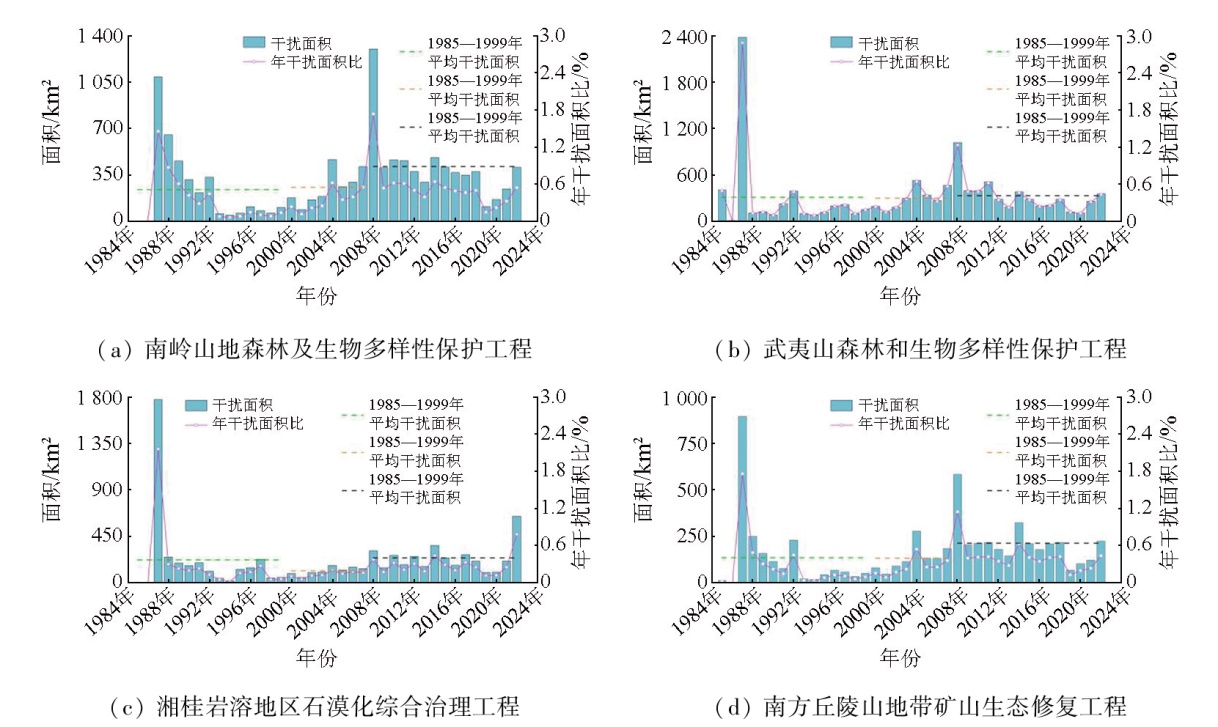
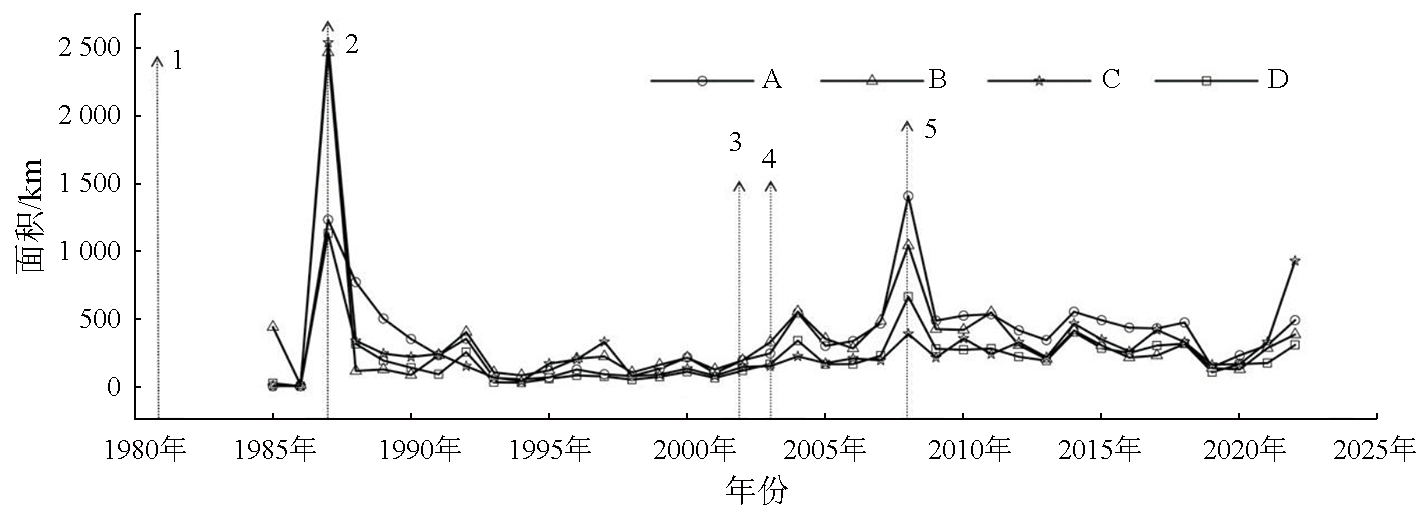
Abstract The South China hilly and mountainous belt is one of the “three regions and four belts” involved in China's major ecosystem conservation and restoration program. This belt hosts the largest and most well-preserved middle subtropical forest ecosystem at the same latitudes globally, playing a crucial role in ensuring the ecological security in South and Southwest China. Based on the Google Earth Engine (GEE) platform, this study conducted preliminary monitoring of disturbances in this belt using the LandTrendr algorithm and the Jeffries-Matusita (JM) distance. It further applied the random forest algorithm to relevant disturbance outputs, enabling the monitoring and analysis of forest disturbances in this belt from 1985 to 2022. The results indicate that the total forest disturbance area in this belt reached 38 564.62 km2 during the study period. Specifically, the disturbance areas of four ecological restoration projects decreased in the following order: Wuyi Mountains forests (12 040.27 km2), Nanling Mountains forests (11 820.79 km2), Hunan and Guangxi karst areas (8 228.97 km2), and mining areas (6 474.59 km2). Based on the 38-year forest loss dataset, this study analyzed the spatiotemporal variations in forest disturbances within this belt, revealing significant spatiotemporal forest disturbances. Spatially, forest disturbances were characterized by distinct geographic clustering. Temporally, the forest loss areas under four ecological restoration projects experienced several stages of change. Despite similar critical transition points and interannual variation patterns, differences in forest resources, climate, and economic conditions led to variations in the areas and trends of forest loss. Besides, the implementation of forestry policies somewhat influenced the forest loss trend. Overall, this study provides a scientific basis and decision-making reference for the management of forest ecosystems within this belt.
|
| Keywords
forest disturbance
South China hilly and mountainous belt
LandTrendr algorithm
spatiotemporal distribution
Google Earth Engine (GEE)
|
|
|
|
Issue Date: 31 December 2025
|
|
|
| [1] |
Watson J E M, Evans T, Venter O, et al. The exceptional value of intact forest ecosystems[J]. Nature Ecology & Evolution, 2018, 2(4):599-610.
|
| [2] |
Shen J, Chen G, Hua J, et al. Contrasting forest loss and gain patterns in subtropical China detected using an integrated LandTrendr and machine-learning method[J]. Remote Sensing, 2022, 14(13):3238.
doi: 10.3390/rs14133238
url: https://www.mdpi.com/2072-4292/14/13/3238
|
| [3] |
Chen C, Park T, Wang X, et al. China and India lead in greening of the world through land-use management[J]. Nature Sustainability, 2019,2:122-129.
|
| [4] |
Zeng W, Tomppo E, Healey S P, et al. The national forest inventory in China:History - results - international context[J]. Forest Ecosystems, 2015, 2(1):23.
doi: 10.1186/s40663-015-0047-2
url: http://www.forestecosyst.com/content/2/1/23
|
| [5] |
潘丹, 陈寰, 孔凡斌. 1949年以来中国林业政策的演进特征及其规律研究——基于283个涉林规范性文件文本的量化分析[J]. 中国农村经济, 2019(7):89-108.
|
| [5] |
Pan D, Chen H, Kong F B. The evolution of forestry policies since 1949:An quantitative analysis based on 283 texts of forest-related normative policy documents[J]. Chinese Rural Economy, 2019(7):89-108.
|
| [6] |
Zhu Z, Woodcock C E, Olofsson P. Continuous monitoring of forest disturbance using all available Landsat imagery[J]. Remote Sensing of Environment, 2012,122:75-91.
|
| [7] |
Masek J G, Goward S N, Kennedy R E, et al. United states forest disturbance trends observed using landsat time series[J]. Ecosystems, 2013, 16(6):1087-1104.
doi: 10.1007/s10021-013-9669-9
url: http://link.springer.com/10.1007/s10021-013-9669-9
|
| [8] |
Wulder M A, White J C, Loveland T R, et al. The global Landsat archive:Status,consolidation,and direction[J]. Remote Sensing of Environment, 2016,185:271-283.
|
| [9] |
Huang C, Goward S N, Masek J G, et al. An automated approach for reconstructing recent forest disturbance history using dense Landsat time series stacks[J]. Remote Sensing of Environment, 2010, 114(1):183-198.
doi: 10.1016/j.rse.2009.08.017
url: https://linkinghub.elsevier.com/retrieve/pii/S0034425709002685
|
| [10] |
Verbesselt J, Hyndman R, Newnham G, et al. Detecting trend and seasonal changes in satellite image time series[J]. Remote Sensing of Environment, 2010, 114(1):106-115.
doi: 10.1016/j.rse.2009.08.014
url: https://linkinghub.elsevier.com/retrieve/pii/S003442570900265X
|
| [11] |
Zhu Z, Woodcock C E. Continuous change detection and classification of land cover using all available Landsat data[J]. Remote Sensing of Environment, 2014,144:152-171.
|
| [12] |
Kennedy R E, Yang Z, Cohen W B. Detecting trends in forest disturbance and recovery using yearly Landsat time series:1.LandTrendr—Temporal segmentation algorithms[J]. Remote Sensing of Environment, 2010, 114(12):2897-2910.
doi: 10.1016/j.rse.2010.07.008
url: https://linkinghub.elsevier.com/retrieve/pii/S0034425710002245
|
| [13] |
Cohen W B, Yang Z, Kennedy R. Detecting trends in forest disturbance and recovery using yearly Landsat time series:2.TimeSync—Tools for calibration and validation[J]. Remote Sensing of Environment, 2010, 114(12):2911-2924.
doi: 10.1016/j.rse.2010.07.010
url: https://linkinghub.elsevier.com/retrieve/pii/S0034425710002269
|
| [14] |
Cohen W B, Healey S P, Yang Z, et al. Diversity of algorithm and spectral band inputs improves landsat monitoring of forest disturbance[J]. Remote Sensing, 2020, 12(10):1673.
doi: 10.3390/rs12101673
url: https://www.mdpi.com/2072-4292/12/10/1673
|
| [15] |
王李娟, 孔钰如, 杨小冬, 等. 基于特征优选随机森林算法的农耕区土地利用分类[J]. 农业工程学报, 2020, 36(4):244-250.
|
| [15] |
Wang L J, Kong Y R, Yang X D, et al. Classification of land use in farming areas based on feature optimization random forest algorithm[J]. Transactions of the Chinese Society of Agricultural Engineering, 2020, 36(4):244-250.
|
| [16] |
Chen D, Stow D A, Gong P. Examining the effect of spatial resolution and texture window size on classification accuracy:An urban environment case[J]. International Journal of Remote Sensing, 2004, 25(11):2177-2192.
doi: 10.1080/01431160310001618464
url: https://www.tandfonline.com/doi/full/10.1080/01431160310001618464
|
| [17] |
Sun K, Geng X, Ji L. A new sparsity-based band selection method for target detection of hyperspectral image[J]. IEEE Geoscience and Remote Sensing Letters, 2015, 12(2):329-333.
doi: 10.1109/LGRS.2014.2337957
url: https://ieeexplore.ieee.org/document/6871325
|
| [18] |
MAUSEL P W. Optimum band selection for supervised classification of multispectral data[J/OL]. Photogrammetric Engineering & Remote Sensing, 1990, 56(1):55-60.
|
| [19] |
Healey S P, Cohen W B, Yang Z, et al. Mapping forest change using stacked generalization:An ensemble approach[J]. Remote Sensing of Environment, 2018,204:717-728.
|
| [20] |
傅伯杰, 王晓峰, 冯晓明, 等. 国家生态屏障区生态系统评估[M]. 北京: 科学出版社, 2017.
|
| [20] |
Fu B J, Wang X F, Feng X M. Ecosystem assessment of national ecological barrier area[M]. Beijing: Science Press, 2017.
|
| [21] |
Yang J, Huang X. The 30 m annual land cover datasets and its dynamics in China from 1985 to 2022[DS/OL]//Zenodo (CERN European Organization for Nuclear Research).(2023-08-01).
|
| [22] |
Liu L, Zhang X, Zhao T. GLC_FCS30D:The first global 30-m land-cover dynamic monitoring product with fine classification system from 1985 to 2022[DS/OL]//Zenodo (CERN European Organization for Nuclear Research).(2023-08-11).
|
| [23] |
el Rosario González-Moradas M, Viveen W, Andrés Vidal-Villalobos R, et al. A performance comparison of SRTM v.3.0,AW3D30,ASTER GDEM3,Copernicus and TanDEM-X for tectonogeomorphic analysis in the South American Andes[J]. Catena, 2023,228:107160.
|
| [24] |
Li P, Li H, Si B, et al. Mapping planted forest age using LandTrendr algorithm and Landsat5-8 on the Loess Plateau,China[J]. Agricultural and Forest Meteorology, 2024,344:109795.
|
| [25] |
Kennedy R E, Yang Z, Cohen W B, et al. Spatial and temporal patterns of forest disturbance and regrowth within the area of the Northwest Forest Plan[J]. Remote Sensing of Environment, 2012,122:117-133.
|
| [26] |
Braswell B H, Schimel D S, Linder E, et al. The response of global terrestrial ecosystems to interannual temperature variability[J]. Science, 1997, 278(5339):870-873.
doi: 10.1126/science.278.5339.870
url: https://www.science.org/doi/10.1126/science.278.5339.870
|
| [27] |
Pan N, Feng X, Fu B, et al. Increasing global vegetation browning hidden in overall vegetation greening:Insights from time-varying trends[J]. Remote Sensing of Environment, 2018,214:59-72.
|
| [28] |
Zanchetta A, Bitelli G, Karnieli A. Monitoring desertification by remote sensing using the Tasselled Cap transform for long-term change detection[J]. Natural Hazards, 2016, 83(1):223-237.
doi: 10.1007/s11069-016-2342-9
url: http://link.springer.com/10.1007/s11069-016-2342-9
|
| [29] |
李亚飞, 刘高焕. 澜沧江流域植被覆盖变化特征及其与气候因子的关系[J]. 资源科学, 2012, 34(7):1214-1221.
|
| [29] |
Li Y F, Liu G H. Characteristics of vegetation cover changes in lantsang basin based on MODIS vegetation index products (MOD13)[J]. Resources Science, 2012, 34(7):1214-1221.
|
| [30] |
Wang C, Ma N, Ming Y, et al. Classification of hyperspectral imagery with a 3D convolutional neural network and J-M distance[J]. Advances in Space Research, 2019, 64(4):886-899.
doi: 10.1016/j.asr.2019.05.005
url: https://linkinghub.elsevier.com/retrieve/pii/S0273117719303163
|
| [31] |
Nguyen T H, Jones S D, Soto-Berelov M, et al. A spatial and temporal analysis of forest dynamics using Landsat time-series[J]. Remote Sensing of Environment, 2018,217:461-475.
|
| [32] |
Breiman L. Random forests[J]. Machine Learning, 2017,45:5-32.
|
| [33] |
朱玮晗, 林金煌, 杨舒棋, 等. 福建省县域森林损失时空演变特征及其影响因素分析[J]. 生态与农村环境学报, 2024, 40(4):499-512.
|
| [33] |
Zhu W H, Lin J H, Yang S Q, et al. Characterization of spatial and temporal evolution of forest loss in counties in Fujian Province and analysis of its influencing factors[J]. Journal of Ecology and Rural Environment, 2024, 40(4):499-512.
|
| [34] |
刘双, 阮宏华. 基于地统计学的广东省和广西省森林生物量和NPP空间格局分析[J]. 生态学杂志, 2013, 32(9):2502-2509.
|
| [34] |
Liu S, Ruan H H. Spatial pattern analysis of forest biomass and NPP in Guangdong and Guangxi provinces of South China based on geostatistics[J]. Chinese Journal of Ecology, 2013, 32(9):2502-2509.
|
| [35] |
Liu C, Wang S, Liu H, et al. Why did the 1980s’ reform of collective forestland tenure in Southern China fail?[J]. Forest Policy and Economics, 2017,83:131-141.
|
| [36] |
韦西勤. 我国速生产林现状与存在的问题[J]. 林业调查规划, 2010(5):115-118.
|
| [36] |
Wei X Q. Current situation and problems of fast-growing and high-yielding plantation in China High-yielding plantation in China[J]. Forest Inventory and Planning, 2010(5):115-118.
|
|
Viewed |
|
|
|
Full text
|
|
|
|
|
Abstract
|
|
|
|
|
Cited |
|
|
|
|
| |
Shared |
|
|
|
|
| |
Discussed |
|
|
|
|
 2025,
Vol. 37
2025,
Vol. 37
 ), YUAN Wubin2, LI Hengkai1(