A comparative study of the methods for delineating wildland-urban interfaces: A case study of Wood Buffalo, Alberta, Canada
WANG Zimeng1(), LIAO Yuanhong1, LOU Shuhan1, BAI Yuqi1,2()
1. Department of Earth System Science, Ministry of Education Ecological Field Station for East Asian Migratory Birds and Their Habitatses, Institute for Global Change Studies, Tsinghua University, Beijing 100084, China 2. Tsinghua Urban Institute, Tsinghua University, Beijing 100084, China
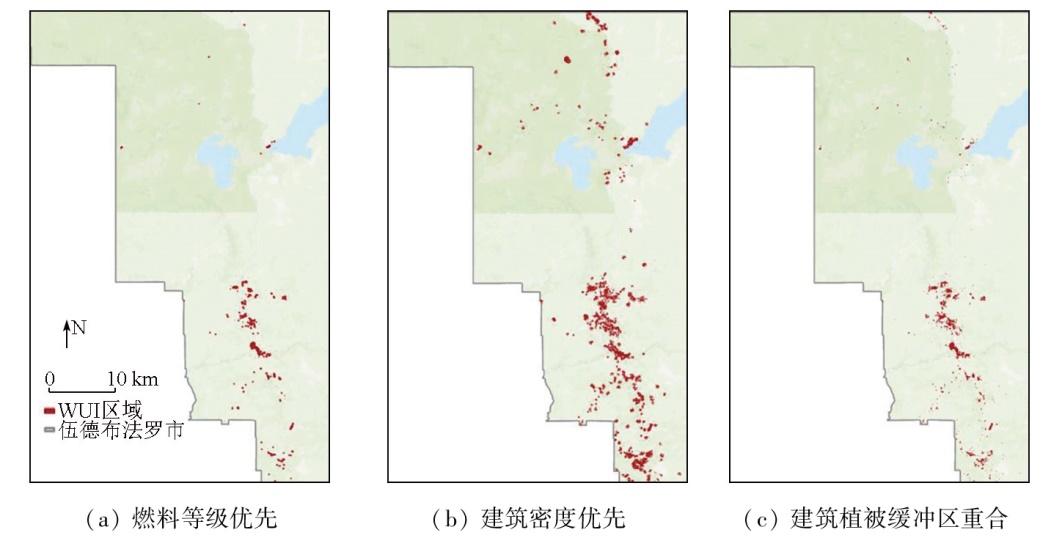
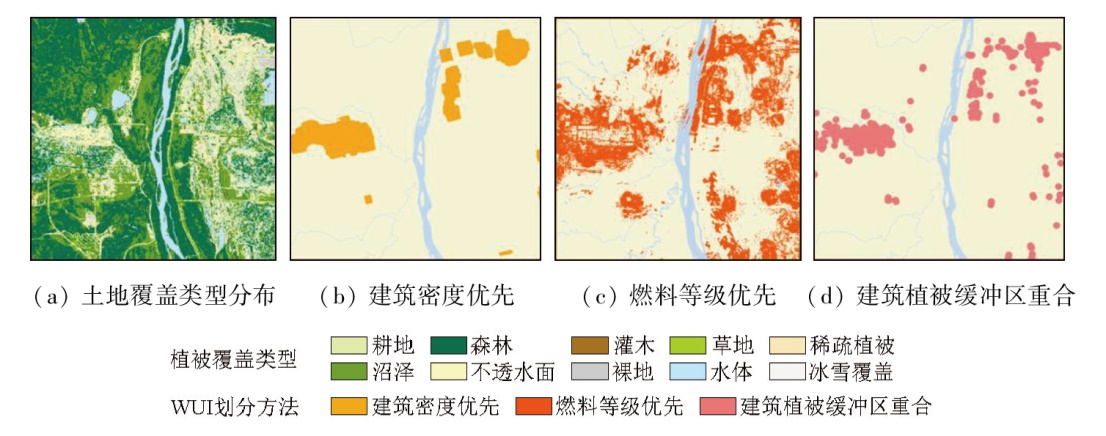
A wildland-urban interface (WUI) refers to the area where residential buildings meet or intermingle with natural vegetation such as forests. The delineation of the WUI plays an important role in fire risk management, forest resource development and utilization, climate change responses, and sustainable socio-economic development. Current methods for WUI delineation are primarily developed and refined based on the definition given in the Federal Register of the United States. Based on indicators such as building density, vegetation coverage, and the distance between buildings and vegetation, these methods can be categorized into three types: building density priority, fuel grade priority, and overlap between building-vegetation buffer zones. Initially, this study presented a summary and comparison of relevant literature on the three types of methods. Then, Wood Buffalo in Alberta, Canada, an area frequently affected by wildfires, was selected to compare the three methods using data on Canadian building footprints released by Microsoft, global land cover from GLC_FCS30-2020, and local historical fire points and fire scars. The results indicate that the building density priority method exhibited the highest coincidence rate with historical wildfire records. However, it overlooked low-density buildings that were also at risk of wildfire. The fuel grade priority method produced a larger delineation area, with a lower coincidence rate with historical wildfire records since it focused excessively on the vegetation around buildings while neglecting the buildings themselves. In contrast, overlap between building-vegetation buffer zones presented the lowest coincidence rate with historical wildfire records and the smallest delineation area. This occurred primarily due to the short distance setting of buffer zones. This study reveals the strengths and limitations of existing methods, contributing to more scientifically robust and rational WUI delineation in the future while also providing references for decision-making in fire risk management and emergency responses.
王梓濛, 廖远鸿, 楼书含, 白玉琪. 森林城镇交界域划分方法对比研究——以加拿大艾伯塔省伍德布法罗市为例[J]. 自然资源遥感, 2025, 37(6): 211-218.
WANG Zimeng, LIAO Yuanhong, LOU Shuhan, BAI Yuqi. A comparative study of the methods for delineating wildland-urban interfaces: A case study of Wood Buffalo, Alberta, Canada. Remote Sensing for Natural Resources, 2025, 37(6): 211-218.
建成区缓冲区100 m内的像元作为候选像元 候选像元500 m半径内植被密度>50% 候选像元距离大型植被斑块<600 m
建筑足迹数据 土地覆盖数据
2023年
欧盟
Modugno等[15]
—
距离建筑区域<200 m 距离野生植被区域<400 m
建筑位置数据 土地覆盖数据
2016年
欧盟
Tab.1 部分WUI划分方法汇总表
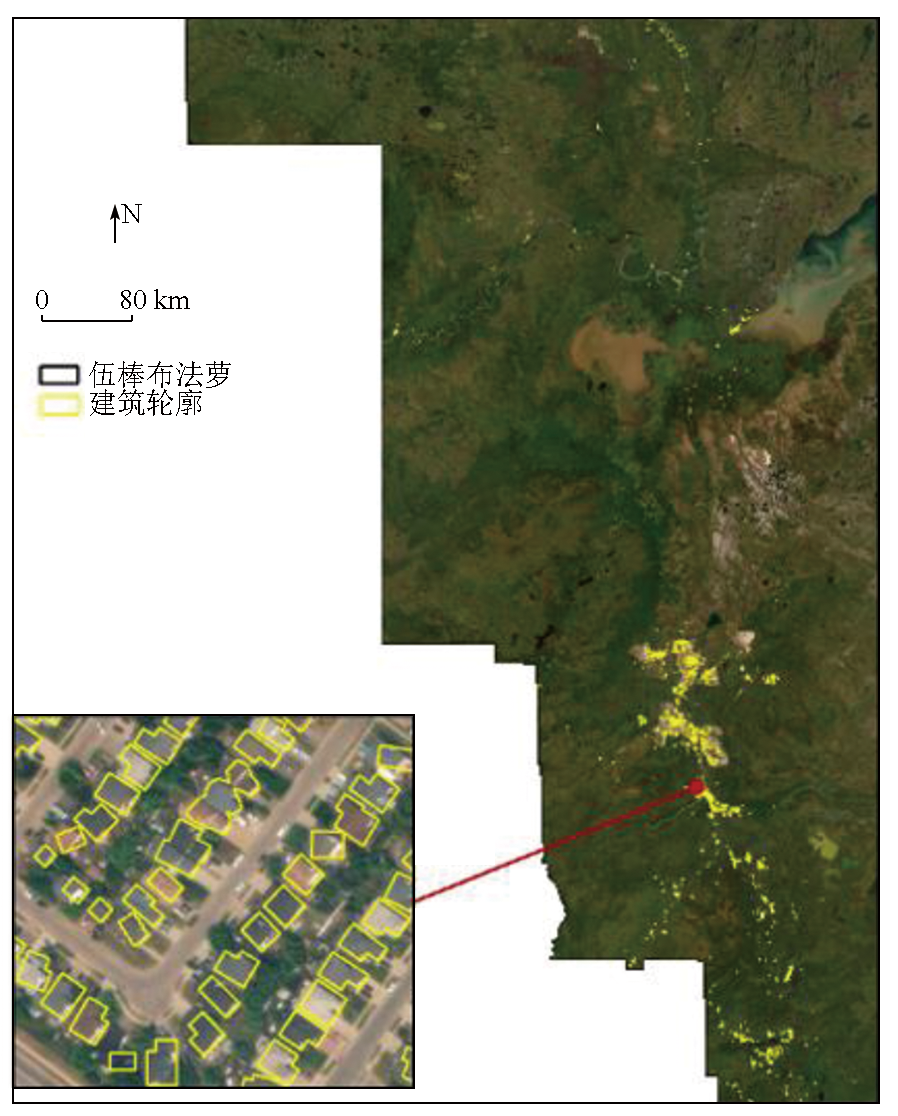
Fig.1 伍德布法罗市区位图
Fig.2 伍德布法罗市建筑足迹分布图
栅格值
种类
燃料等级
71
开阔常绿针叶林(0.15<fc①<0.4)
1
72
闭阔常绿针叶林(fc>0.4)
1
81
开阔落叶针叶林(0.15<fc<0.4)
1
82
闭阔落叶针叶林(fc>0.4)
1
51
开阔常绿阔叶林
2
52
闭阔常绿阔叶林
2
61
开阔落叶阔叶林(0.15<fc<0.4)
2
62
闭阔落叶阔叶林(fc>0.4)
2
91
开阔混交叶片林(阔叶树和针叶树)
2
92
闭阔混交叶片林(阔叶树和针叶树)
2
120
灌木地
3
121
常绿灌木地
3
122
落叶灌木地
3
130
草地
3
152
稀疏灌木地(fc<0.15)
3
180
沼泽
4
150
稀疏植被(fc<0.15)
4
153
稀疏草本植被(fc<0.15)
5
11
草本植被覆盖
5
10
耕地
/
12
树木或灌木覆盖(果园)
/
20
灌溉耕地
/
140
地衣和苔藓植被
/
190
不透水表面
/
200
裸地
/
201
固化裸地
/
202
非固化裸地
/
210
水体
/
220
永久性冰雪覆盖
/
250
填充值
/
Tab.2 不同土地覆盖类型 (GLC-FCS30—2020)的燃料等级相对排名
Fig.3 城市森林交界域划分结果
Fig.4 不同划分方法结果细节对比图
划分方法
建筑位置
对WUI建立的缓冲区距离/m
0
10
50
100
建筑密度优先
火迹地缓冲区内
18 908
18 925
18 954
18 975
非缓冲区内
2 304
2 367
2 414
2 445
燃料等级优先
火迹地缓冲区内
1 528
2 260
8 377
14 579
非缓冲区内
774
1 459
2 537
2 744
建筑植被缓冲区重合
火迹地缓冲区内
16 607
17 010
17 422
17 716
非缓冲区内
1 989
2 665
2 865
3 050
Tab.3 伍德布法罗市不同城市森林交界域的建筑数量
划分方法
WUI总面 积/km2
火点数 量/个
WUI内的 火迹地面 积/km2
占总火迹 地面积比 例/%
占WUI面 积比例/%
建筑密度优先
298.23
655
59.85
0.17
20.071
燃料等级优先
1 682.16
427
277.23
0.82
16.481
建筑植被缓冲 区重合
261.22
629
36.94
0.11
14.143
Tab.4 伍德布法罗市不同WUI内的面积、野火火点数量、燃烧面积
[1]
Wu C, Sitch S, Huntingford C, et al. Reduced global fire activity due to human demography slows global warming by enhanced land carbon uptake[J]. Proceedings of the National Academy of Sciences of the United States of America, 2022, 119(20):e2101186119.
[2]
Kelley D I, Mathison C, Burton C, et al. Likely future (s) of global wildfires[R]. Copernicus Meetings, 2022.
[3]
The UN Environment Programme. 2022.Spreading like Wildfire:The rising threat of extraordinary landscape fires[R].https://www.unep.org/news-and-stories/press-release/number-wildfires-rise-50-2100-and-governments-are-not-prepared.
[4]
Radeloff V C, Hammer R B, Stewart S I, et al. The wildland-urban interface in the United States[J]. Ecological Applications, 2005, 15(3):799-805.
doi: 10.1890/04-1413
[5]
Davis J B. The wildland-urban interface:Paradise or battleground?[J]. Journal of Forestry, 1990, 88(1):26-31.
[6]
Platt R V. The wildland-urban interface:Evaluating the definition effect[J]. Journal of Forestry, 2010, 108(1):9-15.
doi: 10.1093/jof/108.1.9
[7]
Godoy M M, Martinuzzi S, Masera P, et al. Forty years of wildland urban interface growth and its relation with wildfires in central-western Chubut,Argentina[J]. Frontiers in Forests and Global Change, 2022,5:850543.
[8]
Berg A K, Connor D S, Kedron P, et al. Remapping California’s wildland urban interface:A property-level time-space framework,2000-2020[J]. Applied Geography, 2024,167:103271.
[9]
Huang Y, Jin Y. Aerial imagery-based building footprint detection with an integrated deep learning framework:Applications for fine scale wildland-urban interface mapping[J]. Remote Sensing, 2022, 14(15):3622.
doi: 10.3390/rs14153622
[10]
Carlson A R, Helmers D P, Hawbaker T J, et al. The wildland-urban interface in the United States based on 125 million building locations[J]. Ecological Applications, 2022, 32(5):e2597.
doi: 10.1002/eap.2597
pmid: 35340097
[11]
Schug F, Bar-Massada A, Carlson A R, et al. The global wildland-urban interface[J]. Nature, 2023, 621(7977):94-99.
doi: 10.1038/s41586-023-06320-0
[12]
Chen B, Wu S, Jin Y, et al. Wildfire risk for global wildland-urban interface areas[J]. Nature Sustainability, 2024, 7(4):474-484.
doi: 10.1038/s41893-024-01291-0
[13]
Johnston L M, Flannigan M D. Mapping Canadian wildland fire interface areas[J]. International Journal of Wildland Fire, 2018, 27(1):1.
doi: 10.1071/WF16221
[14]
Bar-Massada A, Alcasena F, Schug F, et al. The wildland-urban interface in Europe:Spatial patterns and associations with socioeconomic and demographic variables[J]. Landscape and Urban Planning, 2023,235:104759.
[15]
Modugno S, Balzter H, Cole B, et al. Mapping regional patterns of large forest fires in wildland-urban interface areas in Europe[J/OL]. Journal of Environmental Management, 2016,172:112-126.
[16]
Natural Resources Canada. Canadian wildland fire information system[R].http://bit.ly/WUI-088,2019.
[17]
Beverly J L, Bothwell P. Wildfire evacuations in Canada 1980-2007[J]. Natural Hazards, 2011, 59(1):571-596.
doi: 10.1007/s11069-011-9777-9
[18]
Giglio L, Boschetti L, Roy D, et al. Collection 6 MODIS burned area product user’s guide version 1.0[J]. NASA EOSDIS Land Processes DAAC:Sioux Falls,SD,USA, 2016:11-27.
[19]
Bar-Massada A, Stewart S I, Hammer R B, et al. Using structure locations as a basis for mapping the wildland urban interface[J]. Journal of Environmental Management, 2013,128:540-547.
[20]
Li S, Dao V, Kumar M, et al. Mapping the wildland-urban interface in California using remote sensing data[J]. Scientific Reports, 2022, 12(1):5789.
doi: 10.1038/s41598-022-09707-7
pmid: 35388077
[21]
Glickman D, Babbitt B. Urban wildland interface communities within the vicinity of federal lands that are at high risk from wildfire[J]. Federal Register, 2001, 66(3):751-777.
[22]
Chas-Amil M L, Touza J, García-Martínez E. Forest fires in the wildland-urban interface:A spatial analysis of forest fragmentation and human impacts[J]. Applied Geography, 2013,43:127-137.
[23]
Herrero-Corral G, Jappiot M, Bouillon C, et al. Application of a geographical assessment method for the characterization of wildland-urban interfaces in the context of wildfire prevention:A case study in western Madrid[J]. Applied Geography, 2012, 35(1/2):60-70.
doi: 10.1016/j.apgeog.2012.05.005
[24]
Kumar M, Li S, Nguyen P, et al. Examining the existing definitions of wildland-urban interface for California[J]. Ecosphere, 2022, 13(12):e4306.
doi: 10.1002/ecs2.v13.12
 2025, Vol. 37
  ), 廖远鸿1, 楼书含1, 白玉琪1,2(