Ecological protection assessment of cultivated land in the black soil region based on remote sensing data
SHI Xiaochen1,2(), LUO Chenying2, ZHANG Chao2(), WANG Wei3, CHEN Chang2, BAI Xuechuan2, LI Shaoshuai4
1. Shouguang Municipal Bureau of Natural Resources and Planning, Weifang 262700, China 2. College of Land Science and Technology, China Agricultural University, Beijing 100193, China 3. Da’an Municipal Bureau of Natural Resources, Baicheng 131399, China 4. Land Consolidation and Rehabilitation Center, Ministry of Natural Resources, Beijng 100035, China
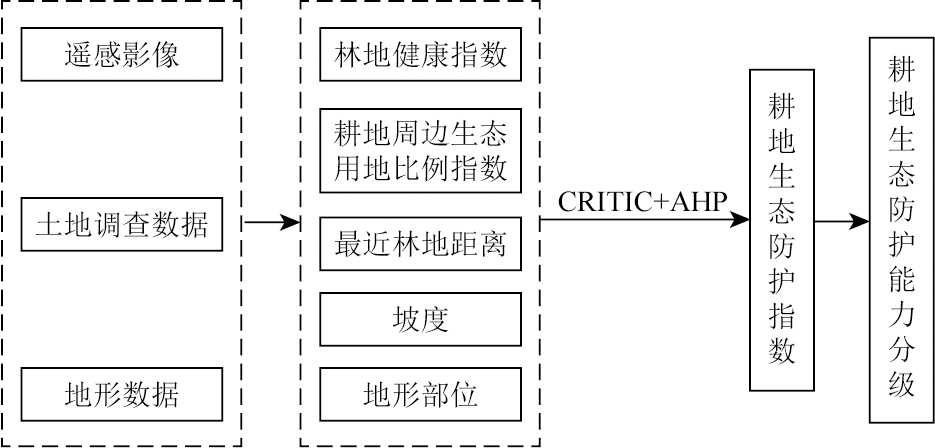
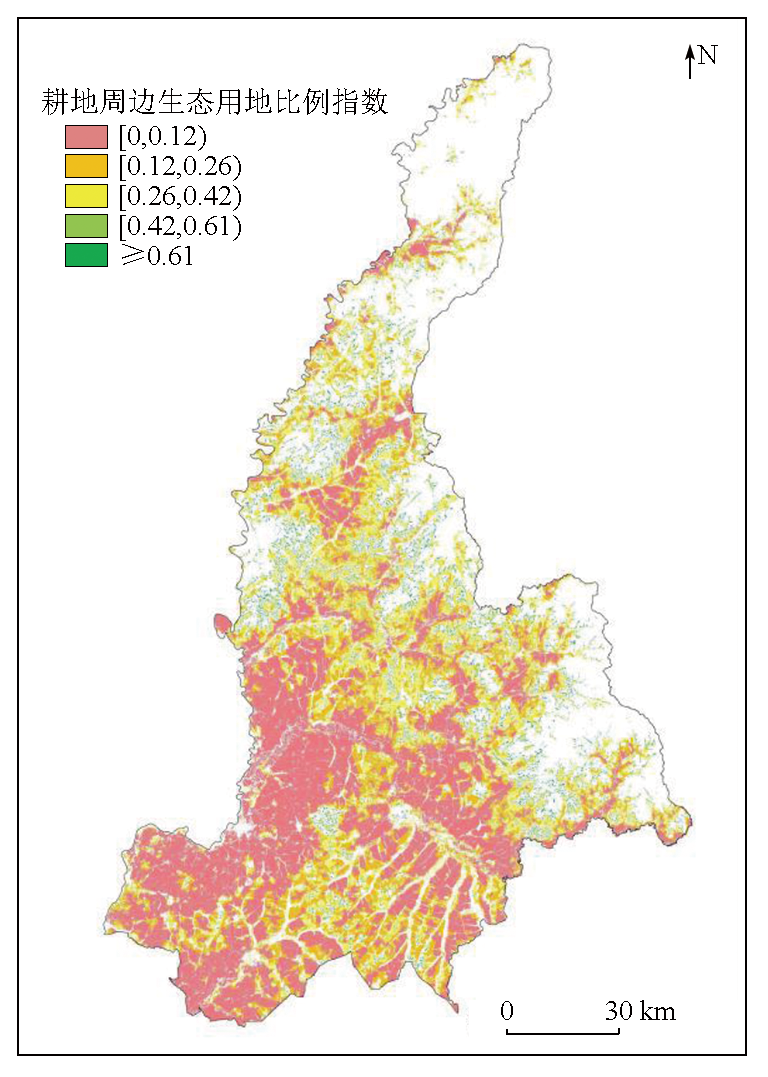
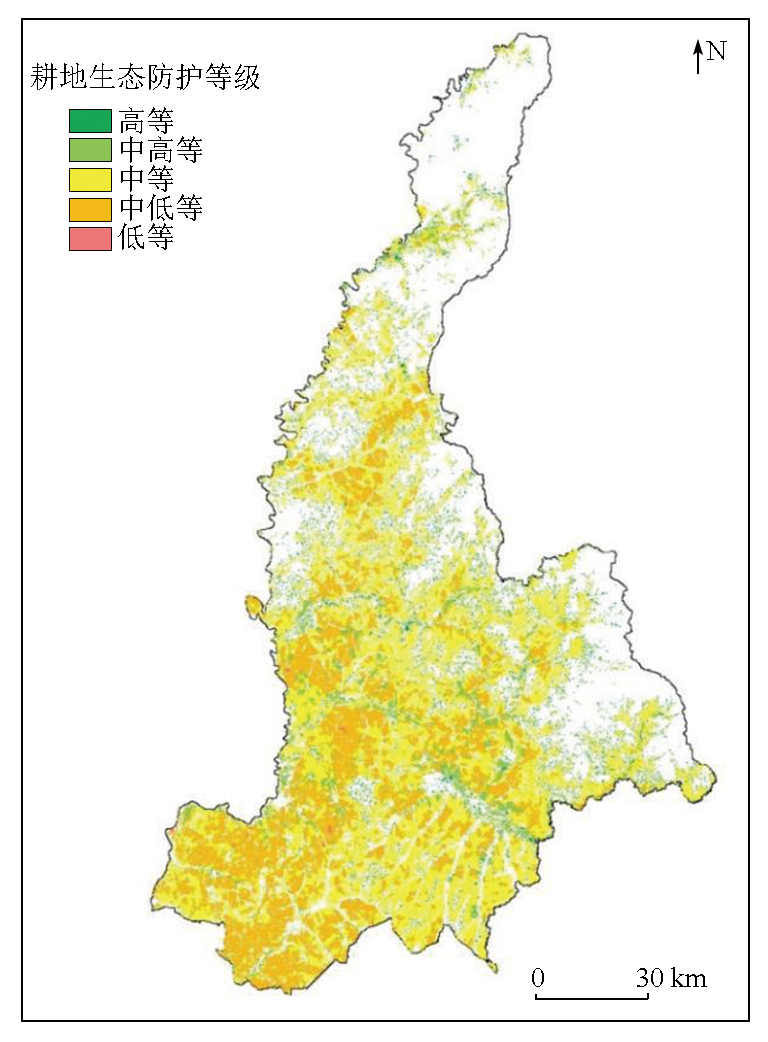
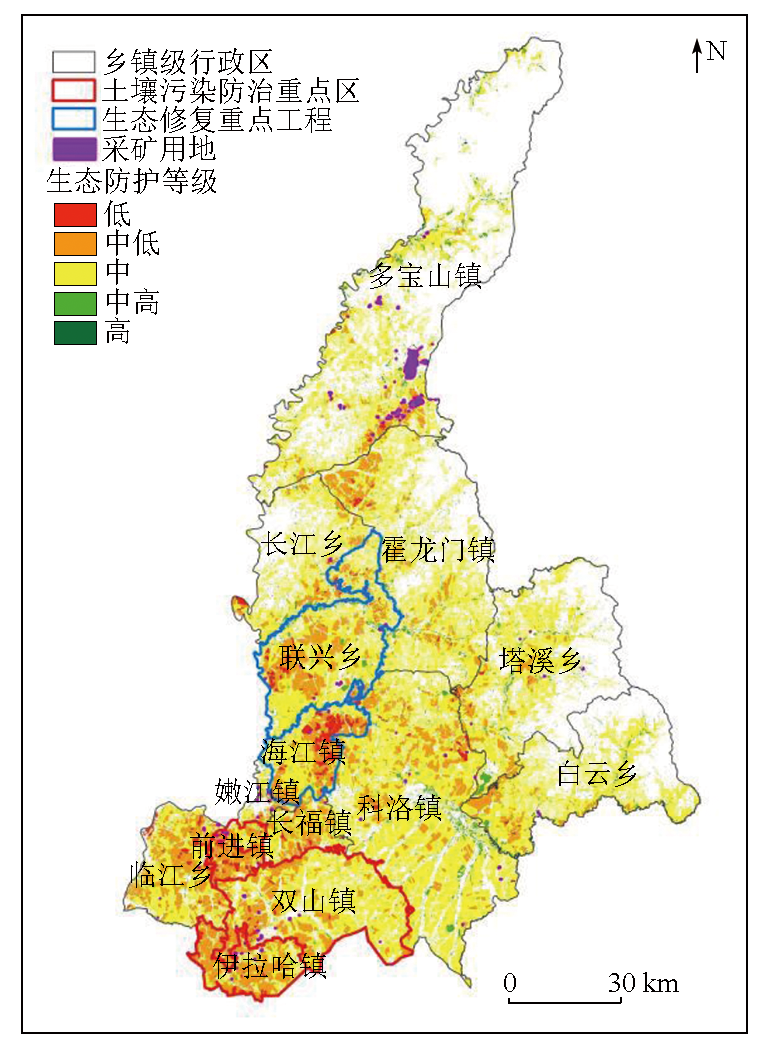
The black soil region in Northeast China is a major grain-producing area in China. To ensure the sustainable development of agriculture in the black soil region, the data from the third national land resource survey, remote sensing data, and the digital elevation model (DEM) can be integrated to explore the ecological protection assessment methods for cultivated land. This study investigated Nenjiang City, Heilongjiang Province, from the location conditions of cultivated land and surrounding ecological land use. It constructed five indicators, including the forest health index, the proportion of ecological land surrounding cultivated land, the distance to the nearest forest, the slope, and the topographic position. Notably, an improved forest health index was designed based on the remote sensing ecological index to comprehensively assess the ecological protection of cultivated land in Nenjiang City. The results indicate that the cultivated land in Nenjiang City was dominated by medium-low and medium ecological protection grades, covering 34.21% and 45.28% of the cultivated land area, respectively. In contrast, the high-grade cultivated land accounted for merely 2.11%, indicating considerable potential for improving the ecological protection grade of cultivated land. Among individual indicators, the proportion of ecological land around cultivated land and the forest health index exhibited low values, serving as the primary factors leading to an overall slightly low geological protection grade in the study area.
史晓辰, 罗晨颖, 张超, 王伟, 陈畅, 白雪川, 李少帅. 基于遥感数据的黑土区耕地生态防护评价[J]. 自然资源遥感, 2025, 37(6): 219-227.
SHI Xiaochen, LUO Chenying, ZHANG Chao, WANG Wei, CHEN Chang, BAI Xuechuan, LI Shaoshuai. Ecological protection assessment of cultivated land in the black soil region based on remote sensing data. Remote Sensing for Natural Resources, 2025, 37(6): 219-227.
Zu J, Hao J M, Chen L, et al. Analysis on trinity connotation and approach to protect quantity,quality and ecology of cultivated land[J]. Journal of China Agricultural University, 2018, 23(7):84-95.
Zhang C, Qiao M, Yun W J, et al. Trinity comprehensive regulatory system about quantity,quality and ecology of cultivated land[J]. Transactions of the Chinese Society for Agricultural Machinery, 2017, 48(1):1-6.
Xu Y D, Pei J B, Li S Y, et al. Main characteristics and utilization countermeasures for black soils in different regions of Northeast China[J]. Chinese Journal of Soil Science, 2023, 54(2):495-504.
[5]
Chidi C L, Zhao W, Thapa P, et al. Evaluation of traditional rain-fed agricultural terraces for soil erosion control through UAV observation in the middle mountain of Nepal[J]. Applied Geography, 2022,148:102793.
Jiang Y, Wang J, Teng H, et al. Coupling coordination analysis of the quality evaluation of cultivated land and soil erosion in typical black soil areas using TOPSIS method[J]. Transactions of the Chinese Society of Agricultural Engineering, 2023, 39(12):82-94.
Zhao Y J, Zheng F L, An X B, et al. Compound erosion effect of snowmelt,wind,and rainfall on sloping farmlands of Chinese typical mollisol region[J]. Chinese Journal of Applied Ecology, 2023, 34(9):2421-2428.
Chen J Z, He Y B, Gao Y H, et al. Farmland damage speed and development stage of gully erosion in typical black soil region from 1970 to 2021[J]. Transactions of the Chinese Society of Agricultural Engineering, 2023, 39(12):51-59.
[9]
徐金忠. 典型黑土区切沟发育关键驱动因素及特征研究[D]. 哈尔滨: 东北林业大学, 2020.
Xu J Z. Gully initial factors and characteristics in typical mollisols area[D]. Harbin: Northeast Forestry University, 2020.
Wei W J, Yuan L, Li W L, et al. Study on the grid calculation results of wind erosion at county scale[J]. Research of Soil and Water Conservation, 2023, 30(4):42-46,52.
Qin Q S. Impacts of erosive force factors on hillslope water erosion process in typical mollisol region of Northeast China[D]. Yang-ling: Northwest A & F University, 2023.
Du Z G, Xiao Y, Zhang R H, et al. Characteristics of soil enzymes and its influencing factors in surface soil of eroded gullies on sloping farmland in the black soil region of Northeast China[J]. Soil and Water Conservation in China, 2023(8):38-43.
Zhang R H, Xiao Y, Xu J Z, et al. Effect of black soil erosion gully evolution on soil structural features and anti-erodibility in sloping farmland[J]. Research of Soil and Water Conservation, 2023, 30(5):69-75.
Liu Y J, Peng J, Li G Y, et al. Eco-environmental assessment of Kurustai grassland based on Google Earth Engine[J]. Chinese Journal of Ecology, 2023, 42(11):2776-2785.
doi: 10.13292/j.1000-4890.202311.010
Xue H, Liu P. Spatiotemporal variation of ecological environmental quality and its response to different driving factors in the section of Yellow River Basin in recent 31 years:Taking Yan’an City as an example[J]. Research of Soil and Water Conservation, 2024, 31(1):373-384.
Liu S Q, Zhang F H, Zhao X Z, et al. Improvement of remote sensing ecological index in oasis in arid area[J]. Science of Surveying and Mapping, 2022, 47(6):143-151,203.
Wang Z X, Liu C, Chen W B, et al. Preliminary comparison of MODIS-NDVI and MODIS-EVI in eastern Asia[J]. Geomatics and Information Science of Wuhan University, 2006, 31(5):407-410,427.
[19]
Son N T, Chen C F, Chen C R, et al. A comparative analysis of multitemporal MODIS EVI and NDVI data for large-scale rice yield estimation[J]. Agricultural and Forest Meteorology, 2014,197:52-64.
Chen X X, Zhang X J, Chang Q R. A study on optimal statistical unit for relief amplitude of land surface in Shaanxi Province[J]. Bulletin of Soil and Water Conservation, 2016, 36(3):265-270,370.
[21]
De Reu J, Bourgeois J, Bats M, et al. Application of the topographic position index to heterogeneous landscapes[J]. Geomorphology, 2013,186:39-49.
Zhang J, Li X D, Chen C Y, et al. Analysis of the relief amplitude in Xinjiang[J]. Journal of Lanzhou University (Natural Sciences), 2008, 44(s1):10-13,19.
Zhang W, Li A N. Study on the optimal scale for calculating the relief amplitude in China based on DEM[J]. Geography and Geo-Information Science, 2012, 28(4):8-12.
Dong L L, Yu L, Han S M. Research progress in farmland shelterbelt planting in China[J]. Journal of Southwest Forestry University, 2011, 31(4):89-93.
[25]
Vigiak O, Sterk G, Warren A, et al. Spatial modeling of wind speed around windbreaks[J]. Catena, 2003, 52(3-4):273-288.
doi: 10.1016/S0341-8162(03)00018-3
Yang X G, Li Y X, Yu Y, et al. Efficiency evaluation of wind protection of windbreaks by GIS[J]. Journal of Northeast Forestry University, 2022, 50(3):77-80,92.
Wang L T, Xiao H J, Xin Z M, et al. Numerical simulation of wind speed field in the typical farmland shelterbelts in the oases of the Ulan Buh Desert[J]. Science of Soil and Water Conservation, 2023, 21(4):11-19.
Li C Z, Zhang C, Zhang H Y, et al. Inversion of soil salinization in western Jilin Province based on XGBoost and geographically weighted regression[J]. Journal of China Agricultural University, 2024, 29(2):1-10.
Zhao X D, Yang Y P, Jing W L. Evaluation on comprehensive suitability of cultivated land in Hunan Province based on AHP[J]. Research of Soil and Water Conservation, 2015, 22(2):219-223,348.
[30]
Xue R, Wang C, Liu M L, et al. A new method for soil health assessment based on analytic hierarchy process and meta-analysis[J]. Science of The Total Environment, 2019,650:2771-2777.
Zhang Y Z, Ren J L, Liu K, et al. The ecological security early warning measures and space-time pattern of Shandong Province[J]. Economic Geography, 2015, 35(11):166-171,189.
He X Y, Nie Y, Wang P, et al. Cultivated land quality evaluation method and demonstration based on improved grey target model[J]. Acta Pedologica Sinica, 2023, 60(4):1007-1016.
Li W B. A study on varied cultivated land quality using site conditions and soil geo-chemistry characteristics as indicators in a peri-urban area of the black soil region[D]. Changchun: Jilin University, 2018.
Qian F K. Study on the planning of basic farmland based on the evaluation system of farmland quality and site conditions:A case study of Lingyuan City in Liaoning Province[D]. Shenyang: Shenyang Agricultural University, 2011.
[35]
Esmaeili E, Shahbazi F, Sarmadian F, et al. Land capability evaluation using NRCS agricultural land evaluation and site assessment (LESA) system in a semi-arid region of Iran[J]. Environmental Earth Sciences, 2021, 80(4):163.
doi: 10.1007/s12665-021-09468-y
Qi L. Evaluation of site conditions of high-standard basic farmland based on LESA system:A case study of Faku County,Shenyang City[J]. Agricultural Technology Service, 2020, 37(1):66-69.
 2025, Vol. 37
  ), 罗晨颖2, 张超2(